Remembering the Service & Sacrifices Made by the Merchant Navy

Merchant Navy Day is celebrated each year on 3rd September.
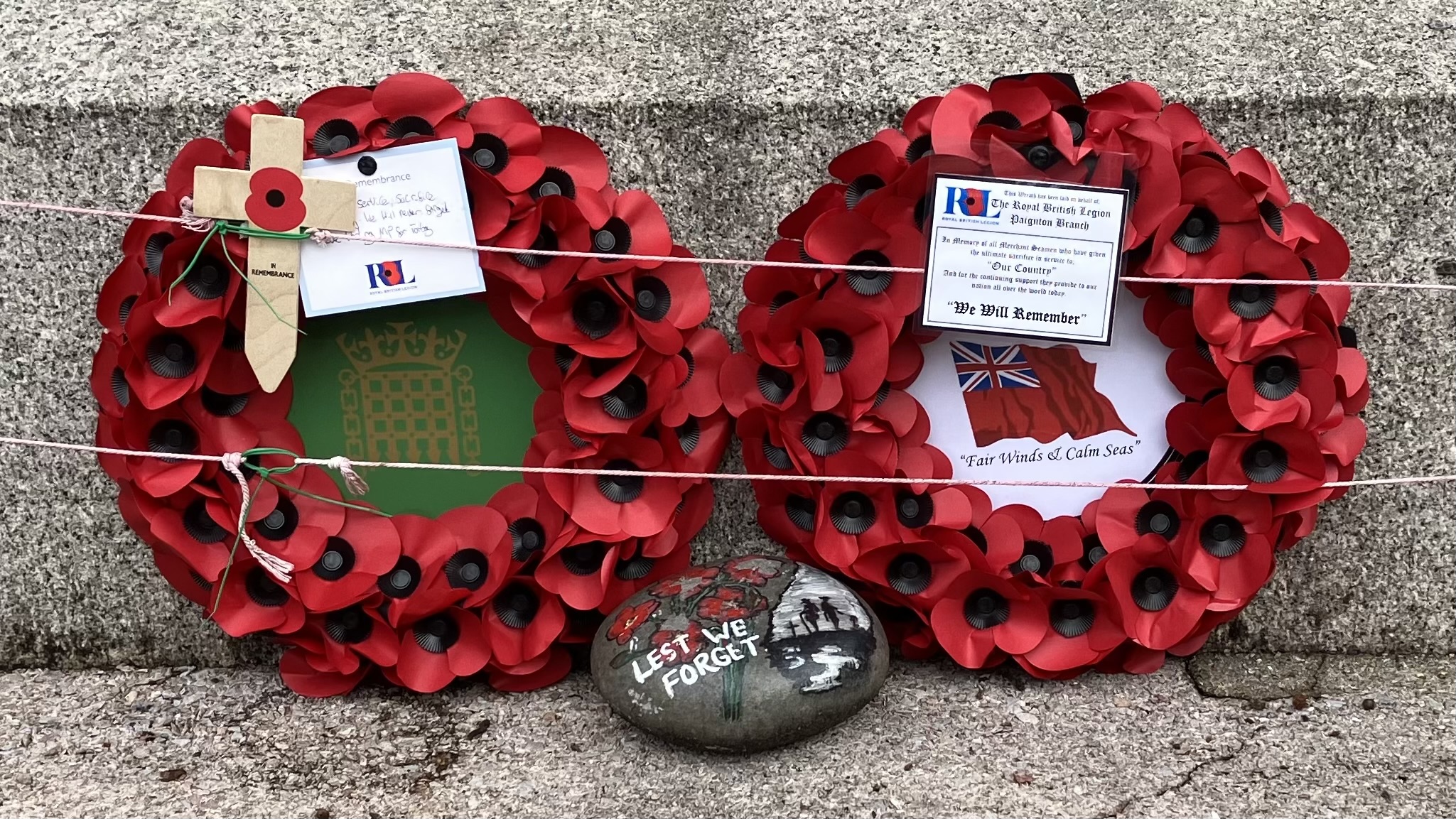
Members of Paignton RBL met on Thursday 3rd September for a short service and laying of wreaths
at the War Memorial in Palace Avenue, Paignton. We were joined by members or Torquay RBL, Torbay Royal Naval Association, representatives of the Merchant Navy Association and local people.

It is our opportunity to remember all those merchant sailors who braved the seas during both world wars to keep our country supplied. It is also our chance to acknowledge the modern day seafarers who are responsible for transporting many of the goods we trade today.
The Merchant Navy has been in existence for a significant period in British history. Tracing its origins back as far as the 17th Century, it became a recognised body known as the Merchant Seafarers in 1835 and grew to become the foremost Merchant Fleet of the 19th Century.
In both world wars our Merchant Fleet suffered heavy losses.
During World War One it lost 7.5 million Tons of shipping along with 15,000 seafarers.
In honour of this sacrifice, King George V granted the Merchant Fleet the title Merchant Navy.
During World War Two, Britain lost almost 12 million Tons of shipping and 32,000 Merchant Seamen.
In recognition of the sacrifices made during the two wars, the Merchant Navy lays wreaths of remembrance alongside the Armed Forces on Remembrance Day.
Below is the text of a message received from a Merchant Navy Officer currently stranded in the Gulf, North of the Straight of Hormuz. He is currently stuck on a gas tanker.
“It is 42 degrees C on deck, the sun bleaching the horizon to a hazy white. Our tanker has sat anchored here for 67 days, just outside the Strait of Hormuz, trapped by regional tensions that have turned one of the world's busiest shipping lanes into a waiting zone. Around us, a forest of super-tankers stretches as far as the eye can see - hundreds of ships, nearly 20,000 crew members stranded together, carrying millions of barrels of oil that cannot move, while we wait for permission, for calm, or simply for news.
Daily life follows a quiet, disciplined rhythm shaped by scarcity and constant lvigilance. I am woken at 0600, the first rule is water rationing. Each person gets just two litres a day for drinking and washing. We collect condensation from air conditioning units to clean clothes or rinse decks. Our fresh vegetables ran out weeks ago. Meals now rely on rice, canned goods, powdered milk and whatever fish we can catch from over the ship's rail; a small way to stretch supplies and keep morale up. Medicines are running low. The heat is relentless. Below decks, in engine rooms or storage spaces, temperatures climb past 50 degrees C. and even laying in cabins feels like sitting in an oven.
But, the hardest part is not the heat or the hunger, it is the tension. Every day, we hear booms, see smoke plumes, or watch drones glide silently overhead. We have painted our ship's name and flag in huge letters along the hull, hoping to avoid being mistaken for a vessel linked to nations caught in the conflict. No one feels truly safe. Work keeps us going. Anything to fill the hours.
Some of us have been away for eight months, or more. For us, it is our daily life, confined, uncertain and suspended between duty and danger.”
This is happening today and we must be grateful for each and everyone serving our country at sea in the Merchant Navy.