Viscount Monty
Field Marshal Montgomery was created 1st Viscount Montgomery of Alamein in the New Year Honours list on 1 January 1946.
King awards George Medal to Andrée de Jongh
King George VI presented the George Medal to Andrée ‘Dédée’ de Jongh, one of the founders of the Comet Line (Réseau Comète), at Buckingham Palace on 13 February 1946. A network of volunteers between Brussels and the Spanish border, the Comet Line helped hundreds of stranded Allied pilots and servicemen escape from occupied Belgium and France during the war. Schaerbeek-born ‘Dédée’ personally led nearly 120 airmen to safety between 1941 and her arrest in January 1943. Held in Fresnes prison in Paris, then Ravensbrück and Mauthausen, ‘Dédée’ refused to reveal details about the escape network. She admitted being Comet’s leader, but the Germans did not believe her which probably saved her life.
As well as receiving the George Medal, Dédée was presented with a clock from an RAF bomber by Air Chief Marshal Lord (Arthur) Tedder and Secretary of State for Air Viscount Stansgate, who declared her exploits as “almost unsurpassed in history”. Looking back, 40 years after she took him across the Pyrenees, Australian pilot Ian Davies declared: “Dédée is a saint. She has more courage in her little finger than I have in my entire body.” After the war, she wed fellow Resistance member Florentino Iñiguez and moved to Africa, dedicating herself to humanitarian work. In 1985, after returning to Belgium, Dédée was made a baroness by King Baudouin. She died in Woluwe-Saint-Lambert on 13 October 2007, aged 90.
Airey Neave, the first British officer to escape from Colditz, got to know Dédée well after becoming an intelligence officer for MI9, which supported Comète and the Pat O’Leary escape line run by another Resistance hero, Albert Guérisse. After the war, Neave wrote Little Cyclone (Petit Cyclone) about Dédée. On 20 October 2024, Neave’s son William unveiled a memorial plaque at the De Jongh family home at 73 Avenue Emile Verhaeren in Schaerbeek.

Andrée de Jongh

Plaque outside her home (author)
Gordon and Catherina
Captain Gordon D. Staple, a future branch Vice-President, married opera singer Catherina Verhaeren on 30 March 1946. Weymouth-born Staple served with the Royal Engineers and landed in Normandy on Sword Beach (Saint Aubin-sur-Mer) in June 1944. Attached to 21st Army Group, he arrived in Brussels soon after the Liberation and fell for Catherina. After the war he came back to Belgium to find his sweetheart. The couple opened The English House, a well-known clothing store run today by one of their three daughters, Margaret.

Gordon and Catherina on their wedding day

Gordon in uniform (Margaret Staple)
Relais sacré aérien
Chair Léon Gyssels represented the branch at a reception in the Hôtel de Ville on 25 May 1946, honouring amputee veterans from Britain, France and Belgium. The veterans took part in a relais sacré aérien (sacred aerial relay), flying from Brussels to Paris, then onto London and back to Brussels. In London, the veterans were greeted by Colonel George R. Crosfield, former National Chair of the British Legion, and Major Sir Brunel Cohen, Honorary Treasurer, both war amputees.
Lionel takes over the reins
A delegation from the branch led by new Chair Lionel Grigson-Page, a veteran of both world wars, greeted Ambassador Sir Hughe Montgomery Knatchbull-Hugessen after a service at the Church of Resurrection in Ixelles on 13 April 1947. The ceremony was conducted by Reverend Philip Moore, the branch Chaplain. The church at rue de Stassart 18 was deconsecrated in 1958 and became a nightclub.

Soldier magazine tribute to Brussels
What we’ll miss most about Brussels
In the immediate post-war period, Brussels continued to be a popular leave destination for service personnel. The July 1947 issue of Soldier, the Army magazine, marked the closure of the British Army of the Rhine (BAOR) leave club by re-publishing a picture of Private Jack Fox, the millionth visitor to the 21 Club, with Private Effie Redden of the Auxiliary Territorial Service (ATS).
The magazine listed what British troops would miss most about Brussels:
... girls wearing ear-rings made from officers’ pips
... hospitable Belgians who invited soldiers to their homes for Sunday roast
... the conductor of the last tram who let the victorious Allies ride on the roof
... the sight of “Vive le Roi” chalked on walls and those who added “d’Angleterre”
... the 21 Club and the Montgomery Club
... Rue Neuve, where a Laurel and Hardy film was always showing
... the Palais de Justice – with the hope it would soon get a new dome
... the tavern with the “English barmaid” sign in the window
After its creation in March 1945, the first 13 issues of Soldier magazine were printed in Anderlecht. From September 1945, it was printed in Hamburg on colour presses previously used for Signal, the Wehrmacht magazine during the war.
(Thanks to Michele Davison, whose mum Maria kept the clipping, and Tudor Morgan, art editor, Soldier magazine).
Wallonia memorial
Lionel Grigson-Page led the branch delegation at commemorations in Wallonia on 10 August 1947. Other members included the Reverend Philip Moore, Vice-Chair, Léon Gyssels, former Chair, J.F. Davis, former Vice-Chair, and Treasurer Major Athelstan Willoughby. They left wreaths on the graves of British airmen in Gembloux cemetery and at the “Rocher Tragique”, where King Albert I met his untimely death in Marche-les-Dames.

Alexander Von Falkenhausen
Van Falkenhausen held
General Alexander Von Falkenhausen, the German former military governor of Belgium, was brought back to Brussels on 26 February 1948 to face trial with his deputy Eggert Reeder. Held on remand for three years, they were sentenced to 12 years hard labour in West Germany but were pardoned by Chancellor Konrad Adenauer soon after the trial ended because of the time they had already served. In 1960, widower Von Falkenhausen married Cécile Vent, former commander of a Belgian Resistance network in Verviers. They met when he was awaiting trial.
Malayan Emergency
Attacks by pro-independence communist fighters sparked the start of the Malayan Emergency on 16 June 1948. The conflict, in which British and Commonwealth forces fought against the Malayan National Liberation Army, lasted more than 12 years.
Summer ball
The branch held a summer ball on 26 June 1948 at the Brussels premises of UFAC (Union des Fraternelles de l’Armée de Campagne) at rue de la Régence 65. Performers included the Billy Bacon Jazz Orchestra and Claude Alix, the stage name of Paula Vandebroek, who sang popular British songs “with brio” according to reports. Attendees included Chair Lionel Grigson-Page, the Reverend Philip Moore, Vice-Chair, and R. E. Higgins, branch Director of Entertainment.
New HQ
The branch opened new premises at 102 Rue de la Loi (now a European Commission building) on 22 July 1948, in the presence of Ambassador Sir George Rendel and Military Attaché Colonel (later Brigadier) Douglas Fabin. Chair Lionel Grigson-Page, the Reverend Philip Moore and R.E. Higgins represented the branch. Léopold Ros, President of the National Confederation of Political Prisoners (Confédération nationale des prisonniers politiques, CNPPA), also attended. He would later become an outspoken critic of Belgium’s controversial King Leopold III, calling for him to abdicate.
Major Willoughby
On 7 October 1948 the branch published a notice in Le Soir announcing the death of Major Athelstan Willoughby, its former Treasurer. Willoughby served in the Durham Light Infantry and was an Honorary Doctor of Laws at Durham University.
Annual ball
The branch’s annual ball on 30 October 1948 at the UFAC drew a large and appreciative audience. Performers included the Billy Bacon Orchestra, Marie Nell (the stage name of Nénette Langlois), dancer Jacqueline Gaspar, and British composer John Cook, a Legion member. Miss J. Daniels of the English Comedy Club recited In Flanders Fields.
Heverlee ceremony
The branch, represented by Colonel Chapman, Major Williams and Lieutenant James, took part in a commemoration at Heverlee war cemetery on 1 November 1948.

Claire and Stanley Whitfield dancing the night away
at the RAF Club in Brussels on 11 December 1948
National Service
National Service, conscription for males aged 17-21, was launched in Britain on 1 January 1949. The men initially served 18 months but this was extended to two years in 1950. By 1963, when the last National Serviceman was demobbed, more than two million had been conscripted to the Army, Royal Navy or Royal Air Force.
Walthère Dewé tribute
On 3 July 1949 the branch was represented at the unveiling of a memorial at 2 rue de la Brasserie, Ixelles, where Belgian Resistance hero Walthère Dewé was killed. Dewé founded two Resistance networks, “La Dame Blanche” in 1916, and “Clarence” in 1940. He was shot by a Luftwaffe officer who confronted him as he was trying to flee Gestapo agents. British historian Helen Fry paid tribute to Dewé and other Belgian intelligence heroes in her 2025 book The White Lady.
Resistance heroine
Madame Verbaet represented the branch at the unveiling of a plaque in Woluwe St Pierre’s Parc Parmentier, honouring Resistance heroine Suzanne Van Durme. Arrested by the Gestapo in 1943, the mother of two died at Bergen-Belsen concentration camp in April 1945. She was closely associated with the Stations de Plein-Air community founded by Father Édouard Froidure, who was liberated from Dachau. Some 2,000 children attended the ceremony on 23 July 1949.
Cadets’ visit
Cadets from the Duke of York’s Royal Military School in Dover arrived in Brussels on 26 July 1949 during a visit to Belgium organised by the British Legion. The cadets stayed with families in Leuven.
Wilsele memorial
Squadron Leader H.C. Wilson represented the Legion at the inauguration of an Anglo-Belgian memorial on 28 August 1949 at Wilsele Churchyard, near Leuven. The monument commemorates 44 British servicemen who lie in the CWGC plot, as well as 82 civilians who died during a bombardment on 12 May 1944.
Belgium backs ‘defence scheme’
Field Marshal Lord Montogomery, accompanied by Ambassador Sir George Rendel, flew into Brussels on 26 September 1949 for talks about Belgium’s role in a new “defence scheme” for western Europe. Monty was welcomed by Prime Minister Gaston Eyskens and Minister of Defence Albert Devèze. The Times reported that Belgium would produce equipment and increase the size of its military.
Committee 1950
The branch announced a new committee on 5 February 1950. Chair: Lieutenant Colonel George Starr DSO MC, Vice-Chair: Lieutenant Colonel E.N. Ackroyd MC, Secretary: Major A. T. Denyer, Treasurer: Captain J. R. Calastreme. Members: E.J. Bacon, R.E. Cameron, C.M. Cooper, J. Hamilton, D.A. Hardy, Dr P. Maurice, J. McCracken, H.N. Mills, Rev P. Moore, H. Powell, K.H. Ross, V.L.J. Snutsel.
Continental HQ
The “continental” section of the British Legion opened premises in Avenue Louise on 15 February 1950 in the presence of Ambassador Sir George Rendel, Major General John Roberts, commander of the Dieppe Raid, General Victor Strydonck de Burkel, former Commander in Chief of the Free Belgian Forces, Lieutenant Colonel George Starr, Chair of Brussels branch, and Count Adrien van der Burch. The guests were received by Squadron Leader H.C. Wilson, head of the Legion’s continental branch, and his deputy Montague Janes.

General de Gaulle making a broadcast in 1941
Anniversary of 'l’appel du 18 Juin'
Vice-Chair Edward Ackroyd represented the branch at a ceremony organised by the Free French Forces Association at Notre-Dame in Laeken on 18 June 1950 to mark the 10th anniversary of the Appeal (“L’appel du 18 Juin”) by General Charles de Gaulle. In his 1940 speech, broadcast from London by the BBC, the future French President urged his compatriots not to give up the fight, declaring: “The flame of the French resistance must not be extinguished and will not be extinguished!” The broadcast was a response to a radio address by Marshal Philippe Pétain the day before, announcing that the fighting had to cease and his intention to ask the enemy for an armistice.

Vice-Chair Lt Col Edward N. Ackroyd MC
(John Stuyck)
Colonel Ackroyd and The Bulletin
Branch Vice-Chair Lieutenant Colonel Edward N. Ackroyd, originally from Yorkshire, settled in Brussels after the First World War and married a Belgian, Rosa Daems. He set up one of the country’s first advertising agencies in the 1930s and was known for his Saville Row suits and bowler hats. The family had to leave Belgium in November 1939 in the wake of the Venlo incident, when two British secret intelligence agents, Captain Sigismund Best and Major Richard Stevens, were abducted by the Gestapo and Sicherheitsdienst (SD) at a café on the Dutch-German border. Ackroyd had connections with MI6 and his life was in danger, according to his grandson, John Stuyck.
The family settled in Harrogate, a spa town in Yorkshire, and John’s mother Monique became a journalist, interviewing bomber crews for the Yorkshire Post. His grandfather, meanwhile, continued in a security role,“vetting” potential candidates to set up administrations in liberated territories. After the war, the family returned to Brussels. Colonel Ackroyd published a newsletter called the Belgian British Bulletin (BBB). When he died in 1962, Monique launched a newsletter from the cellar of her home in Rue des Glaieul, Uccle, based on her father’s idea. Called The Bulletin, it soon became a successful magazine and required reading for expats. Edward’s grandson John took over as publisher in 1987. The title was sold in 2007, three years before Monique Ackroyd passed away. It still exists as a popular website.
Korean War
War broke out between North Korea, supported by China and the Soviet Union, and South Korea, backed by the US and UN, on 25 June 1950. Nearly a million UN troops were deployed during the three-year war, including 14,000 from the UK and 800 Belgians. The British and Belgians were involved in the ferocious Battle of the Imjin River (22-25 April 1951), in which the outnumbered 1st Battalion The Gloucestershire Regiment made a stand against 27,000 Chinese. The Glosters finally surrendered after suffering huge casualties. Lieutenant Colonel James Carne, the battalion commander, was awarded the Victoria Cross. Lieutenant Philip Curtis, killed making a lone attack on an enemy machine-gun, was awarded a posthumous VC. The war ended in stalemate.
Morning Departure
Branch Chair George Starr hosted a gala film premiere of La Nuit Commence A L'Aube (Morning Departure) at the Cinema Metropole on 14 September 1950. Ambassador Sir John le Rougetel MC and two of the film’s stars, Nigel Patrick and Helen Cherry (wife of Trevor Howard), attended the event. The branch was also represented by the Reverend Philip Moore, Kenneth H. Ross, and Starr’s former SOE wireless operator Yvonne Cormeau. Ahead of the screening, the Belgian Naval Force band gave a performance in the city centre. Seats cost from 20-100 Belgian francs.

Lt Col George Starr in service dress
(Alfred Starr)
Death of Chair
Le Soir published a notice announcing the death of former branch Chair Lionel Grigson-Page in Brussels on 21 October 1950. Grigson-Page served in the First World War and as an officer in the RAF in 1939-45. In his civilian life, he represented Radiation Limited, a British company making gas cookers.
Mars memorial
George Starr represented the branch at a ceremony held at the Palais des Académies on 29 October 1950 to commemorate 56 members of the “Mars et Mercure” business association who lost their lives during the Second World War.
Breendonk SS commandant shot
Phillipp Schmitt, former SS commandant of the Fort Breendonk prison camp and Dossin Barracks transit camp in Mechelen, was executed by firing squad in Antwerp on 8 August 1950. He was the last person executed in Belgium. After the war nearly 3,000 people were tried and sentenced to death by military courts in Belgium for collaboration. Only 242 executions were carried out.
Noble gesture
The branch and their counterparts from the Poilus de France jointly hosted a ball at the Concert Noble in Brussels on 2 December 1950 in aid of Belgian children orphaned in the war. VIPs attending the event included Ambassador Sir John le Rougetel and India’s Ambassador to Belgium and Luxembourg, Nedyam Raghavan. Colonel Baron Henry d’Aleyrac Contaud de Coulanges represented the French Embassy. Music was provided by France’s 43rd infantry band and the Belgian Naval Force. Royal Scots Fusiliers in kilts danced to the bagpipes. The 7th regiment of Algerian spahis provided the detachment of honour. Lieutenant Colonel Starr represented the branch with Yvonne Cormeau and E.J. Bacon.
Foch monument
H.C. Wilson, head of the Legion’s Brussels-based continental branch, attended the inauguration of a monument in Laeken on 20 January 1952 to commemorate Marshal Ferdinand Foch. Born just over acentury earlier, Foch was Supreme Allied Commander in 1918. He died in 1929 and was interred at Les Invalides in Paris near Napoleon’s tomb.

George VI
Death of George VI
The branch held a memorial service at the Church of England in rue de Stassart on 15 February 1952 to mark the passing of George VI. The service was conducted by the Reverend Philip Moore. George Starr led the branch delegation which included C.M. Cooper, J.R. Calastreme, E.N. Ackroyd, A. Stimpson, V.L.J. Snutsel, K.H. Ross, G. Donnelly, D. Hardy, G. Mclean, J. Hamilton and M. Lansdowne, as well as H.C. Wilson, head of the Legion’s continental section. The military attachés of Britain, France, the US, the Netherlands and Poland attended, with General Victor Strydonck de Burkel, Colonel Louis Louveau, President of UFAC (Union des Fraternelles de l’Armée de Campagne), and Captain Raymond Moos, President of the Brigade Piron veterans.
Liège tribute
Vice-Chair C.M. Cooper represented the branch at a ceremony on 3 August 1952 organised by the Croix de Guerre federation to honour Belgian regiments based in Liège during the First World War.
Mons memorial
Sir Ian Fraser CBE, the Legion’s National President, took part in the inauguration of the British Empire Memorial in Mons on 11 October 1952. The commemoration was led by King Baudouin. At the ceremony, British Defence Minister Field Marshal Lord Alexander of Tunis recalled his first action nearby as a young lieutenant in the Irish Guards – “a baptism of fire” on 23 August 1914. Other VIPs included Belgian Prime Minister Jean Van Houtte, Major General Sir Edward Spears, British Ambassador Sir Christopher Warner, a Captain in the Royal Fusiliers in the First World War, Canadian Ambassador Lieutenant General Maurice Pope and Victor Maistriau, Mayor of Mons, who was imprisoned by the German occupiers during the First World War.
Committee 1952
The branch announced a new committee on 10 October 1952. Chair: Lieutenant Colonel George Starr, Vice-Chair: C.M. Cooper, Treasurer: J.R. Calastreme. Secretary: R. Galère, Members: A. Stimpson, V.L.J. Snutsel, K.H. Ross, Rev P. Moore, Dr P. Maurice, G. Donnelly, D. Hardy, E.N. Ackroyd, G.E. McClean, A.F.J. Harris, Wood, Robins.

Queen Mary
Death of Queen Mary
Members took part in a memorial service to mark the passing of Queen Mary, widow of George V, at Christ Church in rue Crespel on 31 March 1953. Attendees included Belgium’s Queen Elisabeth and the Ambassadors of Britain, Canada, South Africa and Pakistan. King Baudouin paid his respects at the Chapel Royal, Windsor.
A Queen is Crowned
The branch hosted an “unforgettable” premiere of A Queen is Crowned at the Cinema Vendome on 11 June 1953, in the presence of Belgium’s Queen Elisabeth, Prime Minister Jean Van Houtte, British Ambassador Sir Christopher Warner, Canadian Ambassador General Maurice Pope, and Indian Ambassador P. Achutha Menon. The colour film, with a commentary by Laurence Olivier, was watched by a packed house in almost total silence, punctuated by applause. The Coldstream Guards, resplendent in red tunics and bearskins, provided a guard of honour after earlier paying their respects at the Tomb of the Unknown Soldier, with George Starr and Kenneth H. Ross representing the branch. The coronation of HM Queen Elizabeth II took place on 2 June at Westminster Abbey.

HM Queen Elizabeth II (The Royal Collection Trust)
Peter Townsend joins branch
The branch gained a high-profile member with the arrival of Battle of Britain ace Group Captain Peter Townsend, following his appointment as Air Attaché on 15 July 1953. A former equerry to HM George VI and HM Queen Elizabeth II, divorced Townsend was headline news thanks to his relationship with the Queen’s sister, Princess Margaret. He quickly threw himself into the life of the branch and frequently took part in equestrian events.
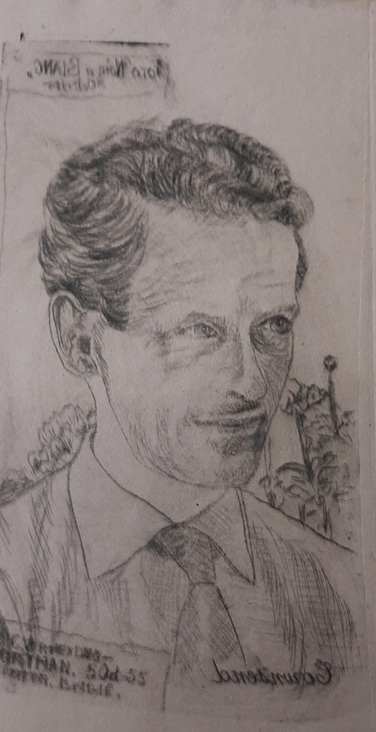
Townsend by Clementine Verheyden
(Royal Library of Belgium)

Princess Margaret
Committee 1953
The branch announced a new committee on 14 October 1953. Chair: Lieutenant Colonel George Starr, Vice-Chair: A.F.J. Harris, Treasurer: J.R. Calastreme. Secretary: R. Galère, Members: E.M. Haskins, V.L.J. Snutsel, A. Stimpson, G.E. McClean, E.P. Warner, G. Donnelly, K.H Ross.
Night at the opera
Chair George Starr represented the branch at the film premiere of L'Opéra du gueux (Beggar’s Opera) at Cinéma L’Écuyer on 26 October 1953. Directed by Peter Brook and starring Laurence Olivier, Dorothy Tutin and Stanley Holloway, the musical was a hit with the audience. It was one of a series of films screened under the patronage of Ambassador Sir Christopher Warner in honour of director, producer and screenwriter Sir Alexander Korda. The others were L’Homme de Berlin (The Man Between), directed by Carol Reed and starring James Mason, Claire Bloom and Hildegard Knef, Le Paradis du Capitaine (The Captain’s Paradise), with Alec Guinness, Yvonne de Carlo and Celia Johnston, and Conquest of Everest. Funds raised from the screenings were shared between the branch, the British Charitable Fund and Royal Air Forces Association among others.

Sir Edmund Hillary and Princess Marie-Claire Amaury de Mérode
with Sir Christopher Warner and Lady Violet Warner (Le Soir)
Peak performer
Sir Edmund Hillary and Lady Louise Hillary attended the premiere Conquest of Everest in Brussels on 29 October 1953. Chair George Starr represented the branch at a reception for the mountaineer. Other guests included Ambassador Sir Christopher Warner, Lady Violet Warner, Indian Ambassador P.A. Menon, Princess Marie-Claire Amaury de Mérode, actress Celia Johnston, star of Brief Encounter, and Group Captain Peter Townsend. Lady Hillary tragically died with her 16-year-old daughter Belinda, two other passengers and the pilot when their plane crashed after taking off from Kathmandu in Nepal on 31 May 1975.
George's Poppy Appeal
Le Soir published an appeal on 7 November 1953 by Chair George Starr, urging the public to support La Journee des Coquelicots (Poppy Day). Under the title “Ne les oublions pas” (Do not forget them), he wrote: “I know that you will not forget the sacrifice of our sailors, soldiers and airmen to make the world free. Many veterans are living in Belgium, having married Belgian women, and we address this appeal to help them, their widows and children.”

Bert Harris and Monette Johnson dancing
the night away at the 1953 Poppy Ball
SOE chief’s visit
Chair George Starr, Peter Townsend and Ambassador Sir Christopher Warner attended a dinner on 25 March 1954 in honour of Roundell Palmer, Lord Selborne, Britain’s former Minister of Economic Warfare, responsible for the Special Operations Executive (SOE) during the war. Starr, code-name “Hilaire”, led the SOE “Wheelwright” network in southwest France from November 1942 to September 1944.
The event was hosted by Colonel Adelin Marissal MC, a veteran of both wars, former agent in SOE’s T (Belgian) Section and President of the Fraternelle des Agents Parachutistes. After escaping to Britain, Marissal served as a pilot in the RAF and then alongside his brother, Colonel Jean Marissal CBE, head of military planning for the Belgian government-in-exile’s 2e direction. On 23 July 1943, Adelin parachuted into Belgium on an undercover mission code-named “Stanley” to link up with resistance cells which would form the nucleus of the Secret Army (Armée Secrète). The operation’s success resulted in the SOE launching a fully-fledged sabotage network, “Hotton”, led by Albéric Maistriau, a former boxing champion and civil engineer who had drilled the tunnel under the Scheldt in Antwerp. The Belgian Resistance targeted industrial plants supporting Germany’s war machine and its communications.
 Lord Selborne (National Portrait Gallery)
 SOE memorial in London (author)
Congo visit
Branch members Colonel Louis Medlam (Britain’s Military Attaché), Group Captain Peter Townsend (Air Attaché), and Wing Commander Edgar “Wally” Wurtele (Canadian Military Attaché) were among a dozen NATO experts invited on a fact-finding trip to the Congo by the Belgian government. They arrived in Léopoldville (Kinshasa) on a Fairchild Packet cargo plane named Vilde Beeste on 17 April 1954.
Death of Rev Moore
The Reverend Philip Moore, branch Chaplain, former Vice-Chair and Rural Dean of Belgium, passed away on 9 July 1954. He was 65. Born in London, he studied at Oxford and served as an Anglican chaplain at various churches on the continent. He returned to Britain during the war, providing pastoral care for anti-aircraft regiments. The funeral took place at the Church of the Resurrection in Rue de Stassart on 12 July. Le Soir paid tribute to him as a “striking member of the British community where he was particularly appreciated”.
10th anniversary
Peter Townsend attended a dinner hosted by Colonel Adelin Marissal on 3 September 1954 in honour of Ambassador Sir Christopher Warner and marking the 10th anniversary of the Liberation of Brussels.
New Chair Bert makes his bow at ball
The branch jointly hosted a bal de l’amitié with veterans of the Brigade Piron on 5 March 1955. It marked the first public appearance by new branch Chair A.E.J. (Albert Francis Joseph) Harris. Known as Bert, he served as a Gunner in the Royal Artillery during the Second World War. Captured by the Japanese following the Battle of Singapore on 15 February 1942, he was among nearly 30,000 British POWs transported to Thailand where they were used as slave labour to construct the infamous Burma-Thailand Railway.
Ambassador Sir Christopher Warner, George Starr, now branch President, H.C. Wilson, head of the continental section, Thomas Lowe Ferguson, chair of the British Colony Association, as well as the Mayors of Molenbeek, Jette and Uccle, Edmond Machtens, Étienne Demunter and Robert De Keyser, were among the attendees at the event.
Organised by a joint committee comprised of Bert Harris, Roger Galère, secretary, and G.H. Lavender, director of entertainments, with Lucien Devis and Pol Schuster of the Brigade Piron’s Brabant Fraternelle, the ball was “unanimously appreciated” according to a report in Le Soir.
Australian tribute
Branch President George Starr, together with Honorary Vice-Presidents Louis Medlam and Edgar “Wally” Wurtele, joined veterans from the Returned Soldiers League of Australia at the Tomb of the Unknown Soldier on 15 May 1955. The Australian delegation included the League’s President Sir George Holland and Sir Frank Beaurepaire, a former world champion swimmer and ex-Lord Mayor of Melbourne. Music was provided by the Royal Scots Greys.
New club-house in Schaerbeek
Honorary life member Olivier Delville, a journalist at Le Soir responsible for the newspaper’s philanthropic activities, hosted a cocktail to celebrate the opening of the branch’s new club-house at 153 Avenue Eugène Plasky, Schaerbeek, on 29 June 1955. Among those attending were Ambassador Sir Christopher Warner, Mayor of Saint-Josse Guy Cudell, branch President George Starr, Chair Bert Harris, and members Louis Medlam, Peter Townsend, Roger Galère, J.R. Calastreme, Kenneth H. Ross and Victor Snutsel.
Namur monument
Chair Bert Harris represented the branch at the inauguration of an equestrian statue in Namur commemorating Albert I. The ceremony on 25 September 1955 was led by King Baudouin and Prime Minister Achille Van Acke.
Committee 1955
The branch announced a new committee on 11 December 1955. President: Lt Col George Starr, Vice-President: Lt Col J. Gerard, Honorary Vice-Presidents: Col W.L. Medlam, Capt F.J. Cartwright, Gp Capt P. Townsend, Wg Cdr E.L. Wurtele, Chair: A.F.J. Harris, Vice-Chair: V.L.J. Snutsel, Secretary: R. Galère, Treasurer: J.R. Calastreme, Archivist: A. Stimpson. Members: G.H. Lavender, Capt H. Reed, J.P. Brown, G. Gaiger, K.H. Ross, H. Heilbron, N. Dewhurst, F.A. Bullock, A.J. Pierarts, E. Johnson, J. Moore, A.J. Thorniley.
 Chair Bert Harris (left) and Standard Bearer
Eric Johnson on duty at a Bastogne parade in 1956
New Ambassador
Vice-President Peter Townsend represented the Embassy and branch at a reception hosted by Colonel Adelin Marissal in honour of Ambassador Sir George Labouchere on 27 January 1956.
Silver jubilee ball
The branch held a ball at the Concert Noble on 4 February 1956 to mark the 25th anniversary of its incorporation by Royal Charter. Featuring the first appearance in Belgium by London’s Victor Silvester Orchestra, the ball was attended by Ambassador Sir George Labouchere, US Ambassador Frederick Alger Jr and Canadian Ambassador Charles-Pierre Hebert.
 The 1956 Poppy Ball, not an inch of dance floor to spare
Harry and Marika
Branch stalwart Harry Moffatt was among half a dozen happily “exiled” former servicemen featured in a Daily Express profile on 12 March 1956. After the Liberation of Brussels, 6,000 Anglo-Belgian couples wed and half, including Liverpool-born Harry and his wife Marika, settled in Belgium. Harry was 21 when he enlisted on 15 September 1939, less than a fortnight after the outbreak of war. After training with the Royal Artillery, he transferred to the Royal Army Service Corps, transporting tanks in the 373rd Company. He embarked for Normandy in August 1944 and took part in the Liberation of Brussels on 3-4 September.
He met Maria “Marika” Uytfries at a party and they married at Etterbeek town hall, with a religious ceremony at Église Sainte Gertrude, on 22 September 1945. The couple set up a laundry business at Chaussée Saint Pierre 311 in Etterbeek. The Daily Express wrote: “A feature of the Moffatt’s laundry is that they sew on missing buttons of your shirt and darn your socks. That is the work of his pretty wife Marie, proud mother of two girls” (Ethel, then eight, and Marlene, two). The couple also had a son, Alan.
Harry joined the Brussels branch at the same time as two of his best friends, Harry Harris and Eric Johnson, and served as a committee member during the 1970s. Daughter Ethel and son-in-law Jean-Pierre Pede, the branch’s current Vice-Chair, followed in his footsteps.

Harry and Marika on their wedding day

Harry in uniform (Ethel Pede-Moffatt)
Good luck, Peter
The branch held a farewell dinner for Vice-President Peter Townsend at the Prince Albert Barracks on 25 September 1956. Ambassador Sir George Labouchere was among the attendees. Townsend revealed his plans for a solo round-the-world trip by Land Rover. The itinerary would take him from Belgium through Luxembourg, Germany, Austria, Yugoslavia, Greece, Turkey, Syria, Iraq, Iran, Pakistan, Nepal, Burma, Singapore, Australia, New Zealand, Malaya, Hong Kong, Japan, San Francisco, Canada, Mexico, Guatemala, Honduras, Nicaragua, Colombia, Ecuador, Peru, Bolivia, Chile, Argentina, Uruguay, Paraguay, Brazil, South Africa, Congo, Libya, Spain, France, and finally back to Belgium. Townsend retired from the RAF after 23 years’ service on 15 October 1956 and set off on his epic adventure less than a week later. He wrote articles for Le Soir during the tour and told branch members he planned to write a book about it on his return to Brussels.

George Starr and Yvonne Cormeau in Essen
Marissal honours Starr and Cormeau
Under the auspices of the branch, Colonel Adelin Marissal, President of the Fraternelle des Agents Parachutistes, hosted a dinner on 14 December 1956 to honour the wartime exploits of Lieutenant Colonel George Starr and his former SOE wireless operator, Yvonne Cormeau MBE. Marissal hailed the pair as “authentic heroes”, describing Starr as the “patron” of the French Resistance who had “always escaped the Gestapo’s traps” in Gascony. Attendees included Hubert Pierlot, Belgium’s wartime Prime Minister in exile, Jean Marissal, Richard C. Bender, US Air Attaché, Thomas Lowe Ferguson, chair of the Anglo-Belgian Chamber of Commerce, and Lieutenant-Colonel Baudouin de Borchgrave d’Altena, head of Belgium’s intelligence services in London during the war.
Adelin Marissal would later be caught up in controversy when his “Mission Marissal” recruited mercenaries from Belgium, France, Britain and South Africa in 1960 to support Moïse Tshombe, the pro-West leader of Katanga which had seceded from the newly independent Democratic Republic of the Congo. Tshombe and two Belgian mercenaries, Carlos Huyghe and Julien Gat, were implicated in the execution of Patrice Lumumba, the country’s first Prime Minister, killed with two ministers, Joseph Okito and Maurice Mpolo, on 17 January 1961. Tshombe, said to be the inspiration for Julius Limbani’s character in 1978 film The Wild Geese, became Prime Minister in 1964. He too was deposed and died in 1969 in Algiers, officially of heart failure, though it was later claimed he was poisoned. His body was flown to Belgium for burial in Etterbeek. Adelin Marissal died on 17 February 1963.
Committee 1957
The branch announced a new committee on 2 January 1957. President: Lieutenant Colonel George Starr, Vice-President: Col J. Gerard, Chair: A.F.J. Harris, Vice-Chair: V.L.J. Snutsel, Secretary: K.H. Ross, Treasurer: J.R. Calastreme, Registrar: R. Galère. Members: N. Dewhurst, T.L. Ferguson, J.P. Brown, J. Donnelly, J. Moore, Mrs J. Moore, A.J. Pierarts, A.J. Thorniley.
Chamber banquet
George Starr represented the branch at the annual banquet of the British Chamber of Commerce at the Hotel Metropole on 14 February 1957. Guests included Jean Rey, Belgium’s Minister for Economic Affairs and future President of the European Commission, Derek Walker-Smith, British Minister of State at the Board of Trade, and the Ambassadors of Britain, Canada, India and Pakistan.
Treaty of Rome
President George Starr represented the branch at a dinner on 16 October 1957 hosted by the Mars and Mercure business association in honour of Ambassador Sir George Labouchere. The Ambassador said Britain backed stronger economic ties with its European neighbours but these would need to be balanced with its commitments to the Commonwealth. (The Treaty of Rome, making Brussels the de facto capital of the new European Economic Community, was signed on 25 March 1957).
Townsend’s return
Former Vice-President Peter Townsend returned to Brussels on 25 March 1958 after clocking up 90,000 km on his solo world trip. He arrived in the early hours at the wheel of the same Land Rover in which he had set off 17 months earlier. It was a brief stopover – Townsend was invited for tea with Princess Margaret in London the following day, leading to an avalanche of media coverage about a possible marriage. Despite two further tête-à-têtes with the Princess, Townsend returned to Brussels on 24 May to write about his travels.
Anglo-Belgian memorial
Chair Bert Harris took part in a ceremony on 20 July 1958 organised with the branch and UFAC (Union des Fraternelles de l’Armée de Campagne) to mark the new site of the Anglo-Belgian memorial. It was moved from Rue des Quatre Bras to Place Poelaert due to the construction of the Stéphanie-Poelaert tunnel. Among the attendees at the ceremony was Brigadier Algernon R. Villiers, British Military Attaché, General Louis Louveau and Lucien Cooremans, Mayor of Brussels.
Townsend documentary
On 26 August 1958 Peter Townsend bade the branch farewell once again when he set off to make a documentary about his recent tour entitled Passport to the World (Passeport pour le Monde). The filming took place in Algiers, Yugoslavia, Nigeria, Pakistan and India. Townsend was accompanied by director Victor Stoloff, photographer Marie-Luce Jamagne (his future wife), and secretary Marguerite Gerard (sister of French actress Danièle Delorme). Speaking to journalists at Vienna Airport on 3 September, Townsend said he would never return to Britain and planned to base himself in Africa.
Expo 58
George Starr represented the branch at the Interallied Congress of Reserve Officers (Congres Interallié des Officiers de Réserve) on 30 August 1958. The congress, attended by Belgium’s future King Albert II, was part of Expo 58. Veterans of the Brigade Piron, joined by Chair Bert Harris, also held their annual meeting at the Expo, from 1-3 September, discussing how to advance “peaceful humanity”.
Barrymaine biography
Le Soir won the Belgian serialisation rights for journalist Norman Barrymaine's biography of Peter Townsend, running extracts in the paper from 22 September 1958. Barrymaine, who served in the RAF in both wars and at the Foreign Office, met Townsend several times in Brussels before his world tour and claimed that the former pilot asked for advice on the book he planned to write after his return. When Barrymaine later told Townsend he was writing his biography, he urged him not to for fear it might prove embarrassing to certain people. However, he read the draft and corrected inaccuracies about his family and time in the RAF, but made no comment on his relationship with Princess Margaret.
In February 1968, Barrymaine was incarcerated by the Chinese after he was caught photographing torpedo boats in Shanghai following a failed attempt to land in North Korea to cover the capture of US Navy spy ship, the Pueblo. Accused of spying for both the Russians and the CIA, Barrymaine was held for 19 months without any outside contact until 11 October 1969. He later became editor and publisher of the China Mail in Hong Kong.
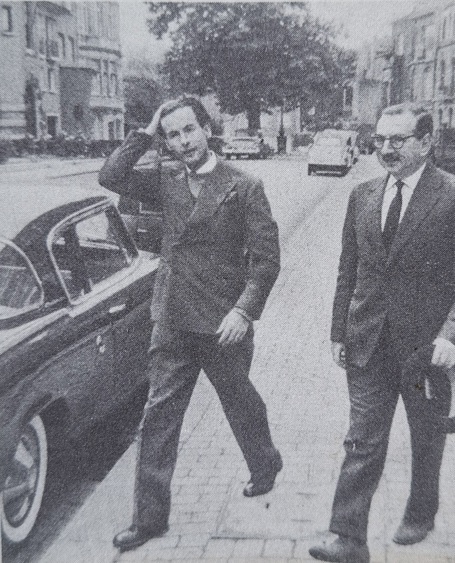
Peter Townsend with Norman Barrymaine in Brussels

The biography

Le Soir hypes the serialisation

Barrymaine at border after release in China (from The Time Bomb)
Doctor honoured
Dr Paul Maurice, branch honorary doctor since 1946, was presented with life membership of the Legion on 16 February 1959 in recognition of the care he had provided to veterans and their families. Captain David Coffer, the Legion’s Deputy Secretary General, made the presentation.
Townsend presents his book – and future wife
Peter Townsend returned to Brussels on 12-13 June 1959 to promote his book Earth My Friend (Terre mon amie) and film Passport to the World (Passeport pour le Monde). Soon after he announced his engagement to Marie-Luce Jamagne (video). The couple married in Watermael-Boitsfort on 21 December 1959. The family later settled in France.
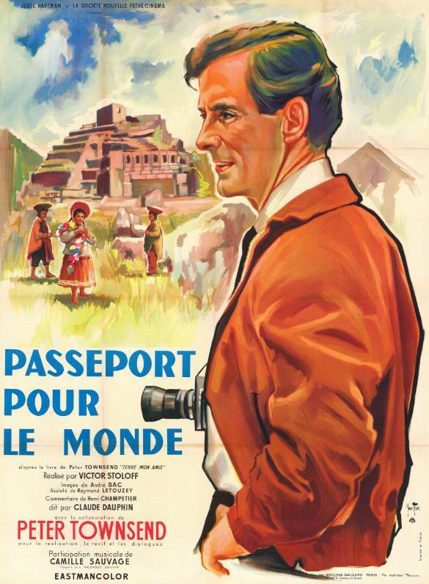 Poster for Townsend film

His book about his tour
 With wife Marie-Luce, son Pierre and daughters Isabelle and Marie-Françoise
(on horse) at their home in Saint-Léger-en-Yvelines, France, in the mid-1970s

With Marie-Luce (left), Marie-Françoise and Isabelle at Christian Dior
ball at Château de Vaux-le-Vicomte in 1985 (Isabelle Townsend)
10,000th Post
The Last Post was sounded at the Menin Gate for the 10,000th time on 8 October 1960. The silver bugles provided by the Brussels and Antwerp branches in 1929 continued in daily use until 1992. Ambassador Sir John Nicholls and his Commonwealth counterparts were in Ypres for the milestone.

Sir John Nicholls (National Portrait Gallery)

