Death of Chair Briscoe
The branch was sad to learn of the untimely death of President and former Chair Captain Ernest-William Briscoe in Uccle on 17 February 1940. Aged just 51, Briscoe was also Chair of the British Chamber of Commerce in Belgium and Director of the Lloyds and National Provincial Foreign Bank in Brussels.

Notice in Le Soir
Green Legion
La Libre Belgique reported on 17 April 1940 that British Legion members and scouts in Britain were joining forces to collect old newspapers and books for recycling. Proof that the Legion was a green pioneer!
Invasion
At about 5am on 10 May, Brussels was awakened by the sound of anti-aircraft fire and bombing. Germany’s long expected attack on the Low Countries had begun.

Military Attaché Lt Col Francis Blake

Sir Lancelot Oliphant (National Portrait Gallery)
Blake escape
After the invasion, Ambassador Sir Lancelot Oliphant KCMG CB and Military Attaché Lieutenant-Colonel Francis Arthur Alexander Blake made for Le Havre on 20 May but, surrounded by advancing German forces, only reached Fort Mahon near Le Touquet. After hiding for three days, they separated. Blake disguised himself as a peasant but was captured and, after a forced march, was held at the town jail in Doullens. Despite having no papers, he managed to conceal his true identity and was released. He spent the next few months incognito with the Lestocard family on an isolated farm halfway between Cambrai and Arras. A friend procured a fake identity card and Blake moved to Douai. From there he was spirited from the “zone interdite” (area of restricted civilian access) to Amiens, hidden on a lorry under cow-hides. He then travelled to Paris by train and eventually to Marseille, arriving on Christmas Day. In January 1941, Blake acquired a passport from the US consulate. It was in his real name but his date of birth was changed so he would appear above military age. Together with a merchant seaman from Inverness, Blake was hidden on a cargo ship which they thought would stop at Gibraltar. Instead, it docked in Algeria, where the pair were arrested and held in cells full of lice. Eventually released and, with the support of an allowance from the US Consul-General, Blake finally reached Gibraltar and left for Britain on HMS Foresight on 21 October 1941. On 13 February 1942 he was awarded the OBE for distinguished service in the field. He wrote a detailed account of his escape, which is held in the British national archives (WO 208/3307/63).
Sir Lancelot, who as a junior civil servant had carried the British declaration of war to the German Embassy in London in 1914, was interned in Germany from 2 June 1940 to 27 September 1941. After his release he returned to Britain where he continued his ambassadorial duties with the exiled governments of Belgium and Luxembourg. His story is told in his 1946 book, An Ambassador in Bonds. Oliphant retired as ambassador in September 1944. He married Christine Spencer, widow of Viscount (Victor) Churchill of Wychwood, in 1939. He died on 2 October 1965, aged 83.
The Hidden Standard
Belgium was forced to surrender on 28 May 1940 after 18 days of bitter fighting ended in the country’s occupation and the evacuation of the British Expeditionary Force (BEF) from Dunkirk. Thousands of Belgian troops were held as prisoners of war. A German administration was established, headquartered at the Hôtel des Colonies close to Gare du Nord, under military governor General Alexander von Falkenhausen. His uncle Ludwig von Falkenhausen held the same post during the First World War.
The Brussels branch of the RBL – all Belgian nationals by then – kept the British Legion standard safely under wraps for more than four years.
Free Belgian Forces
General Victor van Strydonck de Burkel and Emile de Cartier de Marchienne, Belgium’s Ambassador in the UK, launched the Free Belgian Forces at Tenby in South Wales on 28 May 1940. Van Strydonck had a lucky escape from France when his convoy was hit by panzers near Abbeville on 21 May. He made it to Boulogne, crossed the Channel and arrived in London on 23 May. After a meeting 48 hours later with De Cartier and Henri Denis, Belgium’s Minister of Defence, van Strydonck took charge of the Belgian forces in Britain.
By July 1940, Tenby camp numbered more than 450 troops and within six months had doubled in size. At the end of October, the Belgian government in exile in London officially made van Strydonck commander in chief of the Free Belgian Forces. Major (later General) Charles Cumont, Belgium’s former Deputy Military Attaché in London, commanded the 1st Battalion from October 1940 until September 1942. He was succeeded by Major (later General) Jean-Baptiste Piron, who subsequently took command of the 1st Belgian Infantry Brigade after its formation in January 1943. Swelled by 57 fusilier battalions after the liberation, the Free Belgian forces formed the core of the post-war army.
Van Strydonck later became head of the Belgian military mission at the Supreme Headquarters Allied Expeditionary Force, before retiring in 1945. He died in 1961, aged 85.

General VIctor van Strydonck inspects Free Belgian Forces

Ambassador Emile de Cartier de Marchienne

Major (later General) Charles Cumont
Poppy Appeal and Jewish refugees
Belgian newspapers published a controversial interview on 18 March 1941 with Lieutenant Colonel Arthur Lane, author of The Alien Menace and a member of the Imperial Fascist League. In the piece, entitled “Les Juifs s’enrichissent de l’argent de la British Légion”, Lane alleged that funds raised by the Legion’s Poppy Appeal were being used to support Jewish refugees. Today, the Legion’s prescient action, when most were unaware of the unfolding horror of the Holocaust, would be a cause for congratulation.

Flemish SS recruitment poster
 Léon Degrelle, leader of the Rex party
Belgium’s far-right
Germany invaded the Soviet Union on 22 June 1941 (“Operation Barbarossa”). Far-right groups in Belgium who shared the Nazis’ antisemitic, anti-communist ideology quickly formed military units to fight with German forces on the Eastern Front. The Flemish National League (Vlaamsch Nationaal Verbond, VNV), regarded as fellow “Nordics” by the Germans, formed the Flemish Legion (Vlaams Legioen), which became part of the Waffen-SS. On 6 August more than 400 volunteers assembled at the Palais des Beaux Arts for a send-off. Cheered by family and supporters, they marched to the Gare du Nord behind the Flemish flag and Jef François, who commanded the Flemish SS from 1942-44. After training in Dębica (Poland) and Orzysz (then in Germany), Legion Flandern, as it was now known, was sent to the front.
Léon Degrelle, leader of the far-right Belgian francophone Rex party, formed the Légion Wallonie, which held its own cérémonie d’adieu, also at Bozar, on 7 August. The Walloons were not considered Nordic enough to join the Waffen-SS and were attached to the Wehrmacht before being finally integrated into the SS in June 1943.
Some 29,000 Flemings and 17,000 Walloons fought on the German side. In the final months of the war, Flemish and Walloon SS units fought for the first time alongside each other in Pomerania, in what is now western Poland. Jef François and Léon Degrelle both survived the war and were sentenced to death in absentia. François had his sentence commuted to life and was released in 1952. He died in Gent in 1996. Degrelle escaped to Spain where he remained for the rest of his life. He died in Málaga in 1994.
Audacious attack on Gestapo HQ
In an audacious flying feat, Jean de Sélys Longchamps, a Belgian fighter pilot serving in 609 Squadron of the Royal Air Force, launched a single-handed attack on Gestapo headquarters in Brussels on 20 January 1943. Taking a detour after a strafing mission over Gent, he headed for the capital in his Hawker Typhoon. After a low-level pass over his target at 453 Avenue Louise, he flew up what is now Avenue Franklin Roosevelt and Avenue Emile De Mot before blasting the façade of the 12-storey building with his cannon. Several Nazi security personnel were killed. Sélys Longchamps was awarded the Distinguished Flying Cross. In March 1943 he switched to No.3 Squadron, headed by fellow Belgian Léo de Soomer. Sélys Longchamps was killed on 16 August 1943 when the tail of his aircraft came away as he was attempting to land at RAF Manston. He was 31. He was laid to rest at nearby Minster-in-Thanet cemetery. A gilded bronze bust of Sélys Longchamps was unveiled in Brussels’ Avenue Louise in April 1993.

Jean de Sélys Longchamps in RAF uniform

Former Gestapo HQ at 453 Avenue Louise in September 1944, still bearing signs of the attack

Memorial in Avenue Louise

Memorial on the building

Wing Commander Léo De Soomer
(Pictures: Creative Commons and author)
Resistance halts Auschwitz train
More than 25,000 Jews and 350 Roma were transported from Dossin Barracks in Mechelen to Nazi extermination and concentration camps in Eastern Europe during the Second World War. On 19 April 1943, Belgian Resistance members Robert Maistriau, Jean Franklemon and Youra Livchitz used a red paper lantern to trick an Auschwitz-bound train carrying 1,631 men, women and children into stopping near Boortmeerbeek. Seventeen deportees initially escaped, later followed by more than 200 others including 11-year-old Simon Gronowski, before the train reached the border. Around half of the escapees were not recaptured and survived the war. Gronowski, who still lives in Brussels, later became a leading lawyer and jazz pianist.
 Commemorative plaque at Boortmeerbeek station telling the
story of the Jewish 'great escape' (author)
Comet Line heroes executed
Eleven members of the Comet Line, which helped stranded Allied air crews and soldiers escape from occupied Belgium and France, were executed by firing squad at the Tir National in Schaerbeek on 20 October 1943. Following tip-offs from informers, the Geheime Feldpolizei (Secret Field Police), made scores of arrests, notably at the “Swedish Canteen” at 9 rue Ducale in Brussels. An organisation set up by the Swedish Red Cross, the canteen provided food for children in need and a cover for the operational centre of the escape network in 1942-43. Those executed were: Gaston Bidoul, 61; Emile Delbruyère, 30; Eric de Menten de Horne, 29; Jean Ingels, 36; Albert Marchal, 27; Georges Maréchal, 50; Ghislain Neybergh, 33; Henri Rasquin, 51; Antoine Renaud, 52; Robert Roberts-Jones, 50; and Édouard Verpraet, 48. During the Second World War, in all, around 30 Comet Line helpers were shot. Several hundred were deported to concentration camps: many did not return. In his account of the heroism of one the families (A Quiet Woman’s War), William Etherington cites a letter in which Georges Maréchal’s British wife Elsie, a teacher from Norfolk, states that Hermann Göring denied appeals for clemency after Berlin was bombed. Elsie and the couple’s daughter, Elsie Junior, were deported and survived a succession of German prisons and camps.
"Le Faux Soir"
On 9 November 1943, the Front de l’Indépendance, a Belgian Resistance group, produced a spoof edition of the Brussels daily evening newspaper, Le Soir, with articles mocking the Nazi occupation. More than a dozen of the figures behind the audacious stunt were arrested and sent to concentrations camps. The printer, Ferdinand Wellens, and accomplice Théo Mullier did not return. Guy Mottard, an 18-year-old cartoonist, was shot. The key instigator, journalist Marc Aubrion, was due to receive the death penalty but his sentence was later commuted to 15 years. His health was permanently damaged from his incarceration, and he passed away in Brussels, aged only 57 in 1968. The story of the fake newspaper is the subject of two feature films, Un Soir de Joie (1955), directed by Gaston Schoukens, and Le Faux Soir (2026) by Michaël R. Roskam.
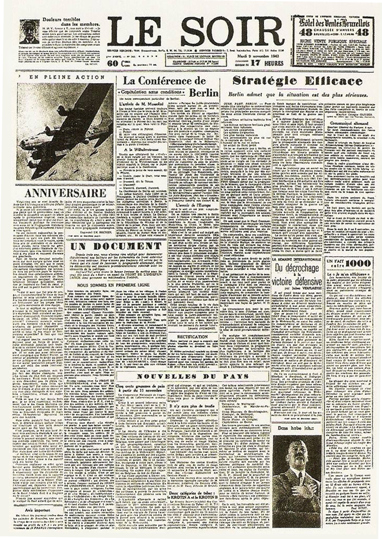
The spoof edition of the newspaper
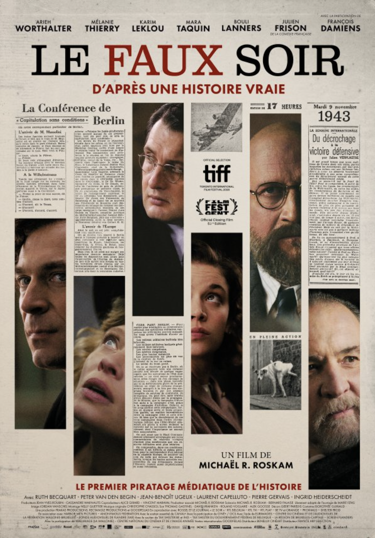
Poster for Michaël R. Roskam's film
Brigade Piron in Normandy
The Brussels branch has enjoyed a long association with the Brigade Piron, lynchpin of the Free Belgian Forces. Under the command of Colonel Jean-Baptiste Piron, 2,200 members of the Brigade landed at Courseulles in Normandy on 7 August 1944, with orders to clear the coast. Édouard Gérard, 20, was killed by mortar fire during their first action at the Battle at Sallenelles – the youngest Belgian volunteer to lose his life. The unit liberated a swathe of Normandy towns including Cabourg, Deauville and Honfleur before joining the push towards Brussels.
Belgian SAS cross frontier
During the night of 15-16 August 1944, nine Belgian SAS landed by parachute in a remote area of the French Ardennes, close to Croix Scaille on the Belgian border. They were Lieutenant Paul Renkin, Sergeant Jack Krolikowski, and Privates Claude Hennequin de Villermont, Fernand Noël, Philippe Gérard, Albert Bogaerts, G. Casier, Jean Mal and Armand Maréchal. Renkin and Hennequin de Villermont crossed the frontier and were the first Belgians to enter the country in uniform since 1940. The pair were killed with another SAS soldier, Private Emile Lorphevre, during the Battle of the Bulge while on operations near Bure on 31 December 1944.
Advance on Brussels
The Guards Armoured Division, under Major General Allan Adair, set up camp on 2 September 1944 at Vitry-en-Artois aerodrome, 10km south-west of Douai, expecting a day or two of rest and to carry out maintenance after their rapid advance from Normandy. But Lieutenant General Brian Horrocks, commander of XXX Corps, surprised his staff by announcing “Operation Sabot”: the division was to advance and capture Brussels – 140km away – the next day. The Grenadier Guards approached the capital via Lessines and Ninove, while the newly-formed Welsh Guards Battle Group followed a parallel route through Enghien and Hal. The two-pronged formation was screened by Household Cavalry reconnaissance squadrons. The 231st Infantry Brigade Group, including the 1st Belgian Brigade, were immediately behind. The Belgians, commanded by Colonel Piron, had moved up from Le Havre. Pockets of German infantry attempted to slow the advance, with little success. As the RAF picked off enemy targets, the British tank crews released yellow smoke to identify themselves and avoid friendly fire.

The route followed by the Welsh Guards

No2 Squadron, 2nd Welsh Guards, in Leuze-en-Hainaut. From left: Sgt T.E. Williams,
LCpl R. Gibson, Gdsm R.T. Pedgeon, LCpl H. Thomas and Sgt G.H. Greenstock (Sgt Charles Hewitt,
No 5 Army Film & Photographic Unit, Welsh Guards Archives, colourised by Tom Marshall)

Enghien welcomes its liberators (IWM)

Then and now: the same street in Enghien (Vincent Florimond)

Guards Armoured Division insignia
The Nazi Ghost train
As the forces closed in on Brussels on 2 September, General Richard Jungclaus, Higher SS and Police Leader for Belgium and Northern France, ordered the deportation of nearly 1,400 political detainees from Saint-Gilles prison, together with 50 captured Allied airmen. They were put on a train at Gare du Midi but the Belgian Resistance ensured it never reached its destination, Neuengamme concentration camp near Hamburg. The original train crew failed to arrive and their replacements tampered with the engine to slow it down. Facing an ultimatum from the Allies and threats from the Resistance to attack German hospital trains, Jungclaus ordered the train back to Brussels. It later became known as Le Train Fantôme and is the subject of a book, The Nazi Ghost Train, by historian and documentary maker Greg Lewis. Sacked by Heinrich Himmler, Jungclaus was transferred to the 7th SS Volunteer Mountain Division and was killed in action in Croatia on 14 April 1945.

The train never reached its destination
Palais de Justice set ablaze and looted
Meanwhile, around 200 troops German soldiers, who had taken over the Palais de Justice in Brussels 48 hours earlier, prepared to evacuate on 3 September. Before leaving, they set incendiary devices around the dome. At around 12.30pm explosions shook the building and the dome collapsed. It is thought the retreating Germans wanted to destroy files that could incriminate collaborators. As the building went up in flames, scores of locals “liberated” Champagne and cognac stored in the cellars. Later, as the building continued to burn, public-spirited residents formed a human chain to save the archives. It took two days to put out the fire. The building was rebuilt between 1947 and 1952.

Smoke pours from the roof of the Palais de Justice (CegeSoma)
Welsh Guards and the Liberation of Brussels
As evening began to fall on 3 September, the Grenadier Guards were held up by enemy action and the 2nd Battalion Household Cavalry were halted on the outskirts of Brussels, leaving the 1st and 2nd Battalion Welsh Guards to seize the momentum. Their fast Cromwell tanks, capable of more than 80km/h, reached the city just after 8pm after a skirmish in Hal. Corporal Sam Boon and Lieutenant Clarke of the 2nd Battalion Household Cavalry led the final dash in an armoured scout car.
The first tank to enter Brussels was commanded by Lieutenant (later Captain) John Dent of the 2nd Battalion Welsh Guards. His crew consisted of Guardsman Bill James (driver), Lance Corporal E. K. Rees (gunner), Guardsman Robert Beresford (hull gunner) and Guardsman Ralph Beresford (radio operator). According to Major Lionel Ellis, author of Welsh Guards at War (1946), Dent’s Cromwell tank destroyed a busload of enemy troops on the Avenue des Arts and knocked out a panzer near the Parc du Cinquantenaire before halting for the night. Lt Dent was later mentioned in despatches in recognition of his gallantry. “It was the best day of his life,” his son Bill told me at a branch dinner to celebrate the 80th anniversary of the Liberation.
The Grenadier Guards soon followed the Welsh Guards into the capital. Lieutenant Roger Dewandre MC, commanding Troop 2 of the Belgian Armoured Car Squadron, also entered the city in the vanguard of the Piron Brigade, guiding General Horrocks and his HQ to Laeken. Dewandre would later become a Lieutenant General. In Place du Trône, Belgian resistance fighters stormed the Electrabel building housing the Oberfeldkommandantur.

Blvd Anspach is nearly empty as Lt Dent's tank arrives

But crowds quickly appear (War Heritage Institute)

Lt Dent's tank in colour (Marcel Vanderstraeten/Soldier Magazine)

Lt Dent in Welsh Guards uniform
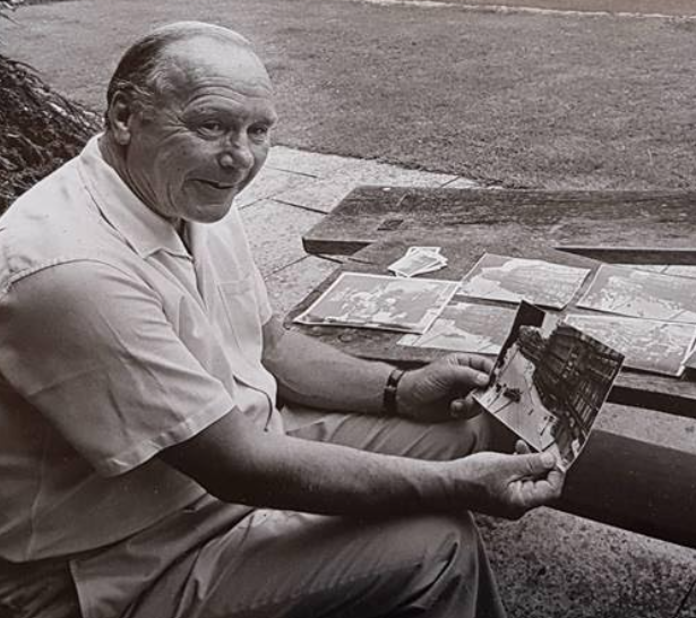
Dent in later life with photographs of his tank in Blvd Anspach (Bill and Rafe Dent)

Liberators at British WW1 memorial (CegeSoma/Archives de l’Etat)

Jubilant civilians ride on a Cromwell (Welsh Guards at War)

Barely a space aboard
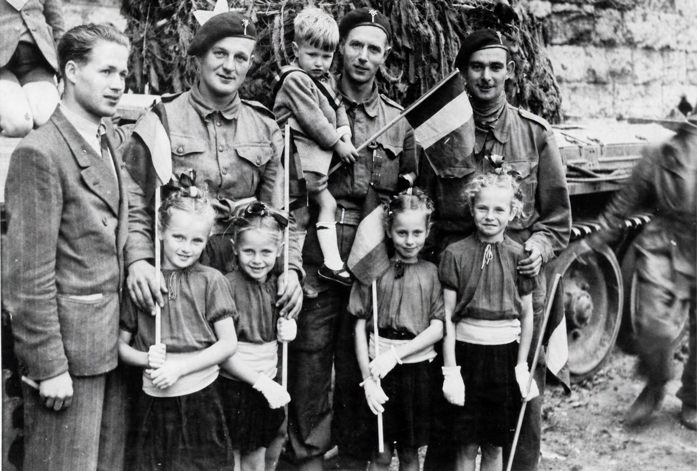
Welsh Guards with youngsters at the Arcades du Cinquantenaire in Brussels
‘Joyous, deliriously excited citizens’
The tanks and jeeps following Lieutenant Dent were quickly engulfed by crowds of well-wishers (footage). Major Lionel Ellis described the scene: “Drivers were kissed, commanders were embraced and garlanded, everywhere was noise and chaos abounding. It was quite impossible to transmit a coherent message over the wireless. Crowds of joyous, deliriously excited citizens barred the way to our tanks, swarmed all over them, screamed salutations to us, pressed fruit and drink upon the tired, dusty, hot tank crews.” But the enemy was still not completely beaten. “What there was left of German resistance in the town was making itself felt; machine guns, anti-tank guns and snipers barked at us. We barked back, the crowds leapt off the tanks and dived into slit trenches, porches of houses and any other cover that presented itself. The opposition was not heavy and was soon overpowered. The crowds emerged from their slit trenches and over-ran the tanks again.”

Major Jack Trefusis, Scots Guards
How Scots Guards officer duped enemy
In one of the most incredible incidents of the Liberation, Major Robert ‘Jack’ Trefusis of the Scots Guards single-handedly received the surrender of more than 50 German troops threatening to set the Hôtel de Ville ablaze. German-speaking Trefusis, a divisional “spearhead officer” on the staff of XXX Corps commander General Horrocks, quietly made it into the capital during the afternoon of 3 September in an unarmoured Austin P.U. (pickup utility) vehicle with two Guardsmen and two civilians directing them on what he called a “devious route” through Anderlecht to the Avenue de la Porte de la Hal.
Maj Trefusis recalled how they “spurted” across the road in front of German troops before finding themselves stuck behind an enemy tank – whose crew were fortunately unaware of their presence.
Trefusis somehow made it to his planned drop-off point at a police station in Rue Tête-d’Or, close to the Hôtel de Ville. Still unobserved, he clambered up open-air ducts to reach the first floor where he found himself face-to-face with burgomaster Frédéric Van de Meulebroek and his terrier dog, Rip.
There was no time for pleasantries. More than 50 Germans were in library, about to set it on fire.
Trefusis recalled: “I strode in and told them British troops were here and they must surrender at once. I think they were so surprised at being ordered to do so in their own language they luckily complied. German troops were still in the square below but were obviously withdrawing.”
After handing over the POWs to a police commander, Albert Tasseel, Trefusis requistioned city maps from shops to distribute to the Guards as they arrived. Soon after, he found himself on the balcony of the Hôtel de Ville with Van de Meulebroek.
After being demobilised in 1946, Trefusis entered the British diplomatic service and was later director-general of the Hydraulic Association. He chaired the Talbot House Association for nearly 30 years. A devout Christian, Trefusis was a church-warden at St James’s Piccadilly, and a volunteer guide at Exeter Cathedral. He died in Exeter on 13 May 1997 (obituary). His son Charles, a vicar in Woodbridge, Suffolk, attended the 80th anniversary commemorations in Brussels.

Gabrielle and her mother Madeleine (Anita Tedder)
Collaborators feel heat
Gabrielle Douat, then 17, recorded her memories of the Liberation. “From our flat in Rue Antoine Bréart [Saint-Gilles] you could see the Palais de Justice was [still] on fire … it was a terrible sight, very frightening. I went out … I suppose just to see what was going on. I went to the maison communale, which was quite close by. All these signs to different towns and different places had been pulled down by the people, on the orders of the Resistance ... There was this tank going round in round in circles because he just couldn’t find his way. The trouble was he was opening his machine gun and beginning to shoot around … I went to the Chaussée d’Alsemberg, the big street that goes from Place Albert down to La Barrière. I looked up and that’s when I saw my mother [Madeleine]. She was running down the street, as fast as she could go, in her high heels, and she was mad. She had a man by the scruff of his neck. He was clutching something … she made him go back to where a big bonfire had been lit in the middle of Chaussée d’Alsemberg … In a top flat on the right-hand side, people had invaded this particular flat because the flat had been inhabited by collaborators. They were chucking everything from the flat onto the street and people had set fire to it. My mother had seen this guy take a piece of whatever it was and she made him put it back on the bonfire.”
While isolated German troops put up a stubborn resistance, others fled before the British broke through. “[Earlier] mother and I had gone down into town and we had lunch … opposite La Bourse … suddenly it went very quiet, the trams seemed to disappear. These Germans went by on bicycles, but the bicycles didn’t have any tyres. They’d looted them … and were trying to get out of Brussels. [A while later ] I saw two young Germans in an armoured vehicle … they were just sitting in this thing, I suppose waiting for orders. I put my tongue out at them … by the afternoon the two boys had disappeared. Later that night, around nine o’clock, I was back on that particular spot and this time there were big tanks there … a British soldier came up to me ... He said: ‘How old are you?’ ‘17’. The British were back.” After the war, Gabrielle married a British soldier, Tom Tedder.

General Allan Adair on his command tank, surrounded by crowds
in Brussels (Bert Hardy, No 5 Army Film & Photographic Unit)

Crowds salute liberators during victory parade

Brigade Piron flash
Brigade Piron joins Guards for victory parade
On 4 September, the 1st Infantry Brigade of the Free Belgian Forces arrived in Brussels, to link up with the British Guards. The Welsh Guards’ War Diary recalls: “Presents of every sort were still being showered on the troops, and it should perhaps be recorded that in spite of the numerous and enormous quantities of drink available, no-one appeared to be the worst for wear.” The British and Belgian troops took part in a Liberation Parade, amid scenes of huge jubilation (clip). Irish-born officer Chaim Herzog, a future President of Israel, was among those serving in the Guards Armoured Division.
Branch member Kathleen Johnson treasures a photograph taken during the liberation celebrations. She found it in an album belonging to her father, the branch’s long-serving Standard Bearer Eric Johnson BEM. The second lady from the right is her maternal grandmother and the second from the left is her aunt, who was dressed in a black skirt, yellow blouse and red hat – the colours of the Belgian flag. Eric, serving with the Royal Army Service Corps, was among the first wave of British troops to arrive in Brussels. Little did he know it would be his future home!

Kathleen's relatives celebrate the liberation with friends (Kathleen Johnson)

Eric (left) and RASC comrade. Eric would become a branch legend
Liberation of Antwerp
Antwerp was liberated by the 11th Armoured Division commanded by Major-General Philip ‘Pip’ Roberts CB DSO MC (clip) on 4 September. The British tanks arrived from the south via Boom, crossing the River Rupel and Willebroek Canal. The bridges leading to Antwerp were mined and Belgian Resistance hero Robert Vekemans diverted the lead tank column near Breendonk, pointing out a safer route.
Jean-Pierre Schellekens, then aged eight, vividly recalled the scene as the tanks arrived in his street, Jan Van Rijswijcklaan. “A few hours before there had been a panzer outside and my father told us to get in the cellar. We waited but nothing happened. Then suddenly the panzer was gone and we heard the clanging of the British tanks. We stormed out. It was absolute delirium. What you felt was unbelievable. The tanks stopped and I climbed on the first one. I was on the small flat side next to the turret. Someone was holding on to me so I wouldn’t fall. It was fantastic. One of the things I remember most is the smell of sweat and gasoline as well as the clink, clank, cronk of the tracks turning. Suddenly, Flemish SS started firing and somebody got me back inside very quickly. I didn’t see any blood but I saw falling and I knew there were casualties.”
Captured Germans were held in cages at the zoo and collaborators faced reprisals. “I remember a café on the corner of Isabellastraat. When I came past it a few days after the liberation I saw people throwing all the furniture – everything they could – into the street,” said Schellekens, who later served as a Lieutenant-Colonel in the Belgian Air Force Reserve and was a leading figure in the Comité National Belge du Souvenir (Belgisch Nationaal Herdenkinsgcomite). He passed away in Brussels on 1 September 2025, aged 89.

Jean-Pierre was eight when city was liberated
Monty at Everberg
Promoted to Field Marshal on 1 September 1944, 21st Army Group commander Sir Bernard Law Montgomery set up his tactical headquarters (TAC HQ) in the grounds of the Château de Merode at Everberg on 7 September 1944. He had occupied the same site before the British retreat in May 1940.
Home of Marie-Claire de Croÿ, Princesse de Merode, the château previously provided quarters for the Luftwaffe’s Mölders Squadron, who left just hours before Monty arrived. Everberg was Monty’s base for two weeks, until 21 September. His 21st Army Group’s main headquarters was located at the Residence Palace in Brussels’ Rue de la Loi. Belgium’s General Victor van Strydonck de Burkel also set up a base in the building.
Soon after arriving at Everberg, Monty made a flying visit to Brussels to meet mayor Frédéric Van de Meulebroek. The El Alamein hero was accompanied by Brigadier Desmond Gordon, commander of 151st Brigade, garrisoned in Brussels, and Colonel Jean-Baptiste Piron. As news of Monty’s arrival at the Hôtel de Ville rapidly spread, crowds flocked to the Grand Place. After signing the livre d’or, he made his way to the balcony where he was acclaimed with cries of “Monty, Monty, Monty” and the crowd sang “For He’s A Jolly Good Fellow”. Monty also met Queen Elisabeth of the Belgians at the Palace.
The following days were spent planning Operation Market Garden. Monty conferred with British Second Army commander Lieutenant General Miles Dempsey at the Chateau de Ribaucourt in Perk, hoping to allay his subordinate’s concerns about the airborne operation, which would prove a bridge too far at Arnhem. Dempsey had favoured attacking 55 miles further south, with flank support from the US Army, but Monty over-ruled him.

Monty set up his TAC HQ in the grounds of the Château de Merode

Monty meeting burgomaster Frédéric Van de Meulebroek (Le Soir)

Monty at the Chateau de Ribaucourt

Lt Gen Dempsey and the Ribaucourt family
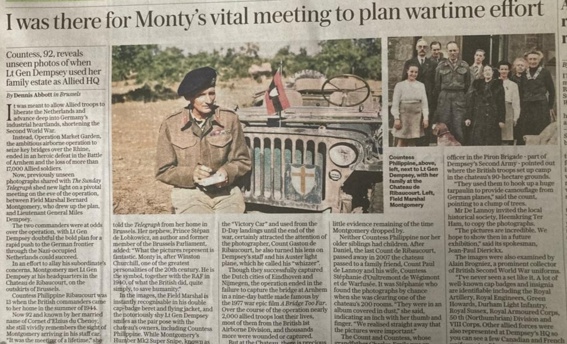
Article by author about Market Garden meeting (Sunday Telegraph)
Belgian Resistance
It is estimated that more than 150,000 Belgians engaged in the resistance during the Second World War, with around 2.5% of the population involved. Around 40,000 resistance fighters were arrested, more than half of them in 1944. Almost 15,000 died in action, by execution or while imprisoned. (Source: ‘Why the Belgian Resistance deserves more attention’, Nico Wouters and Bruno De Wever). Historian Dany Neudt set up a site dedicated to the Belgian Resistance (Helden van het verzet) in the wake of a huge public response to a social media post about Suzanne Spaak. A database run by CegeSoma/State Archives of Belgium contains information about nearly 65,000 Resistance members.
House warming
In a column in English entitled “For our allied friends”, La Dernière Heure reported on an “informal house-warming” on 3 October 1944 at the new headquarters of the British Legion at 82A rue Veydt, Ixelles. “Old Legionnaires now in Brussels are desired to get in touch either with Mr L.R. Gyssels, Chair of the Brussels branch of the B.L. or with Captain J.F. Davis,” said the notice. The same report also stated that Ambassador Sir Hughe Montgomery Knatchbull-Hugessen would open a canteen and reading room in the Methodist Church at 5 rue du Champ de Mars, Porte de Namur, on 5 October.
Tir National memorial
Branch members, accompanied by British and US officers, took part in a ceremony on 8 October 1944 to pay their respects to civilians executed during the Occupation. Cardinal Archbishop Jozef-Ernest van Roey, a steadfast opponent of Nazism, conducted a service at the Tir National in front of an altar where a monument to Edith Cavell had stood until the Germans ordered its removal. The ceremony was attended by Charles, the Prince Regent, Queen Elisabeth, Colonel Louis Louveau, President of the UFAC (Union des Fraternelles de l’Armée de Campagne), and Arthur Dejase, Mayor of Schaerbeek, who was imprisoned by the occupying forces for organising a ceremony in 1942 to honour Gabrielle Petit, a resistance fighter shot by the Germans during the First World War.
British Legion Standard flies again
The front pages of Le Soir and La Dernière Heure on 19 October 1944 pictured Brussels committee members proudly showing their British Legion standard, which was hidden during the Occupation. Chair Léon Gyssels and Vice-Chair Captain J.F. Davis, formerly of the 13th Gloucestershire Regiment, welcomed Ambassador Sir Hughe Montgomery Knatchbull-Hugessen to the branch’s new premises, and he accepted their invitation to become patron. The members thanked him by singing “For He’s A Jolly Good Fellow”.
Knatchbull-Hugessen had a notable diplomatic career. In 1937, when he was Ambassador to China, he was wounded and lucky to survive when a Japanese fighter strafed his car. While Ambassador to Turkey from 1939-1944, it emerged that his chauffeur had regularly opened his mail and sold secret material to the Germans. Knatchbull-Hugessen survived the scandal and was appointed Ambassador to Belgium later the same year, retiring in 1947.
 Chair Léon Gyssels (right) and Sir Hughe, alongside him,
celebrate the re-emergence of the Hidden Standard
Coupe British Legion
A football match on 28 October 1944 between Royal Léopold and the Royal Electrical and Mechanical Engineers (REME) ended in a 2-1 victory for the 'visitors' who lifted the “Coupe British Legion”.
Maj Bob Mélot MC and F/Sgt George Thompson VC
Major Robert “Bob” Mélot MC, a Belgian serving in Britain’s Special Air Service (SAS) Regiment, was killed on 1 November 1944 when his jeep crashed near Ronquières. A decorated First World War veteran known as the “Grandfather” of 1 SAS, he volunteered for Britain’s armed services on the outbreak of war when he was working for a carpet company in Egypt. Already in his 40s, he was turned down due to his age. Instead, he joined the ISLD (Inter-Services Liaison Department), a cover name for the secret intelligence service in North Africa, which led to him to joining the SAS. Mélot, who left a wife and two daughters in Knokke, was buried with military honours at the war cemetery in Evere where the branch holds a commemoration every June. The cemetery is the last resting place of 670 casualties from the First and Second World War. Among the other notable burials is Flight Sergeant George Thompson VC, who died after beating out flames with his bare hands to rescue a fellow member of the crew when his Lancaster bomber was hit during a raid over Dortmund-Ems Canal on 1 January 1945.

Major Mélot

Comrades carry his casket

Mélot's grave at Evere

F/Sgt George Thompson VC (IWM)
Poppy Appeal 44
For the first time since the start of the war, Belgian boy scouts and guides took part in the Poppy Appeal on 11 November 1944. “By wearing a poppy, Belgians will express their gratitude to their liberators,” reported La Dernière Heure.
Better stockings
In the months following the liberation, hundreds of British servicemen were based in Brussels – and no small number ended up in relationships with Belgian women. Many would stay and become stalwarts of Brussels branch. Lieutenant Colonel Charles Carrington MC, later Professor of History at Cambridge University, captured the lively atmosphere in the city in his book Soldier At Bomber Command: “Brussels is less gloomy than Paris: there are trams, dim street lights and cafes. In the brasseries, hundreds of Tommies, Belgian girls and bon-bourgeois families enjoy the singing. The girls have better stockings and worse shoes than English girls. They talk broken English better than the soldiers talk broken French.”
Love at first sight
Branch member Claire Whitfield (née Stroobant) was 18 when she met her husband-to-be, Flight Sgt Stanley Whitfield. She was walking her dog near the Prince Baudouin barracks in Schaerbeek when she spotted the young RAF man climbing down from a truck. “It was love at first sight,” she recalled. In the days after the liberation “young people had a lot of catching up to do”. Stanley took Claire to the 21 Club, a British forces venue in Rue d’Assaut. Named after the 21st Army Group, the idea for the club came from British holiday camp tycoon Billy Butler, honorary secretary of the Navy, Army and Air Force Institutes (NAAFI). The 21 Club quickly took off, with hundreds of couples regularly packing the dance-floor. Stanley and Claire married at Holy Trinity in Rue Crespel on 18 May 1946.

The 21 Club, where 'young people had a lot of catching up to do'
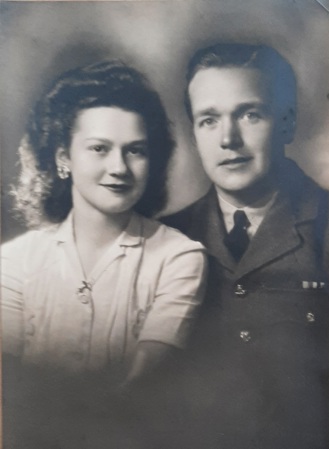
Claire and Stanley after the liberation
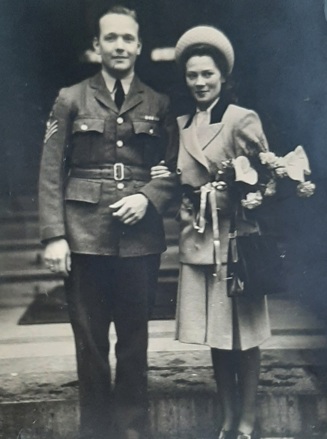
On their wedding day
David Niven
Among the British troops stationed in Brussels after the liberation was film star David Niven, who had re-enlisted in the British Army when the war broke out. Major Niven commanded A Squadron GHQ Liaison Regiment, also known as Phantom, and landed in Normandy shortly after D-Day. When leading his unit into action he would encourage them by saying, “Look, you chaps only have to do this once. But I’ll have to do it all over again in Hollywood with Errol Flynn!” Niven ended the war as a Lieutenant Colonel before returning to acting and films in which he often played military roles such as A Matter of Life and Death, Carrington V.C., Separate Tables, The Brain, The Guns of Navarone and Escape To Athena.

David Niven in uniform
Lee Miller captures Brussels
Another famous visitor to Brussels after the liberation was the acclaimed wartime photo-journalist Lee Miller. A muse for Man Ray and Pablo Picasso, Miller featured in the avant-garde Jean Cocteau film The Blood of a Poet, before moving behind the camera.
She arrived in Brussels after covering the liberation of Saint-Malo for Vogue. Flown into Belgium by the RAF in November 1944, Miller spent several days capturing the atmosphere in the capital. Her feature was published in the February/March 1945 issue of Vogue, whose cover she had previously adorned as a model, under the title ‘Brussels – more British than London’.
She was struck by the huge number of soldiers in the city. “It’s organised and geared to entertain thousands of British troops on forty-eight hour leave passes from the front. There are no more civilian hotels in Brussels; they all belong to the soldiers. Hot baths, bed and board. There are dozens of theatres, music halls and cinemas, a big ENSA [Entertainments National Service Association] show and dance-halls, opera, horse races, and the dogs – day and night,” she wrote.
“The traditional Belgian love and admiration of the English is tangible. There are many who have cultivated and imitated the English accent in their French, others who copy the clothes and mannerisms of the English,” she added.

Ex-model had her uniform altered in Savile Row so
it fitted snugly (US Army Center of Military History)
Miller photographed Lieutenant Colonel Hardy Amies, the Savile Row tailor who became dressmaker to HM Queen Elizabeth II, in the Parc Cinquantenaire. Amies spent the war as a secret agent in Belgium with the Special Operations Executive. The Queen would later tell friends that her couturier “was very good at garrotting Nazis”. Amies took Miller to meet his friends Count Henri d’Ursel and his wife Madeleine. Miller described the Count’s eldest daughter Thérèse “whose ‘baby-face’ .. had been such a perfect passport for her activities in the resistance movement. She is reported to have carried millions of francs in her handbag .. delivering funds for arms and bribery, for saboteurs and the hidden army.”
Miller also dined with German-born Prince Bernhard (“in uniform, spectacled, friendly and boyish”), the husband of future Dutch Queen Juliana. Bernhard was an early member of the Nazi Party but switched his allegiance after the invasion of the Netherlands.

Lt Col Hardy Amies in the Parc Cinquantenaire

Miller's article about Brussels (Leo Cendrowicz)
Miller was impressed by the spirit of the Belgian population during their four years “under the heel”. She wrote: “Every housewife knew how to pass a German in the street without seeing him; to be pushed off the pavement without losing dignity, to ignore having the last tit-bit snatched from the head of the queue; to be stolid under insults, negative to the questioner and speechless when tortured.”
She praised charities, particularly the Red Cross, which had “stoutly refused to be bullied by the Germans into neglecting their duties toward the families of deported and executed people”.
Miller had visited Brussels before the war and was keen to re-acquaint herself with friends from the surrealist movement. She photographed René Magritte, Paul Delvaux, Tatave (Paul-Gustave) van Hecke and Nadine Lalys, daughter of a First World War resistance heroine.
Following the Allied advance into Germany, Miller’s harrowing pictures of Nazi concentration camps at Buchenwald, its subcamps of Ohrdruf and Penig, as well as Dachau, brought the horrors of the war to a wider public. In Munich, she found Hitler’s abandoned apartment at 16 Prinzregentenplatz. It still had hot water and she decided to have a bath. Before climbing into the Fuhrer’s tub, she placed her boots, still covered in mud from Dachau, on the mat and set up her camera. Life photographer David E. Scherman, her then romantic interest, captured the moment. The apartment is still in use as a police station to prevent it becoming a pilgrimage site for the far-right.
After the war, Miller married the British surrealist and art historian Roland Penrose. They lived in Hampstead and later at Chiddingly, East Sussex, where she served meals on a silver platter liberated from Hitler’s mountain retreat at Berchtesgaden. Kate Winslet portrayed Miller in ‘Lee’, a biographical feature film released in September 2024.

Miller lunched with troops at the Malcolm Club (Leo Cendrowicz)

The Malcolm Club guide included a handy map of Brussels

The club provided bed and board as well as a canteen
Malcolm Club
The Malcolm Club in rue Léopold, where the Dominican Hotel now stands, provided bed and board as well as a canteen for airmen, run by Baronne Jean (Louise) Rolin. In her Vogue article, Lee Miller wrote :“A bevy of her girls wait on table and wash dishes. Princess Elizabeth de Ligne is one of them.” The Malcolm Clubs, first set up in North Africa, were named after Wing Commander Hugh Gordon Malcolm VC, who was killed in action near Bizerta, Tunisia, on 4 December 1942. He was 25.
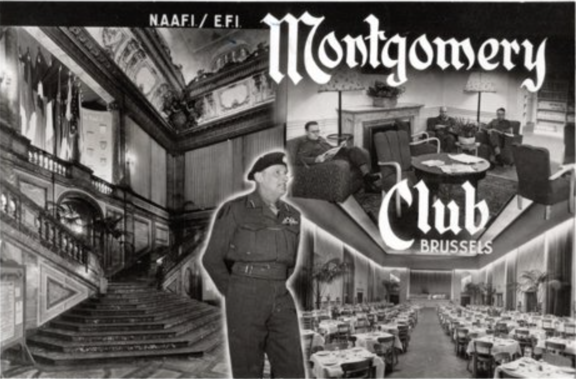
Postcard featuring the Montgomery Club
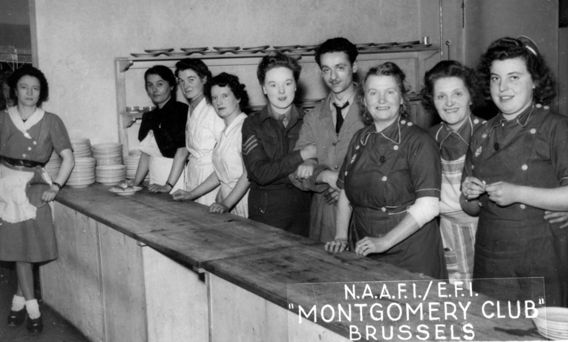
Staff at the Montgomery Club
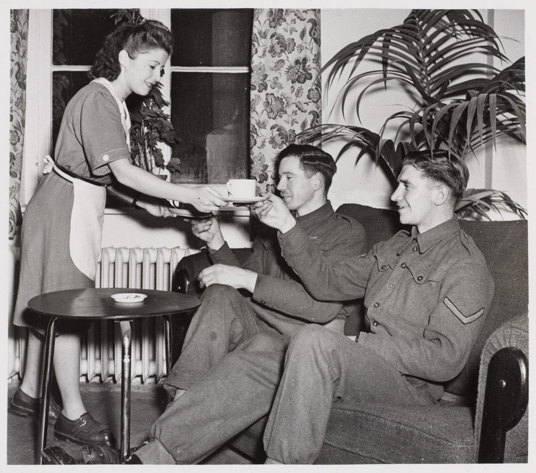
Service with a smile


The Montgomery Club offered a wide range of attractions for troops on leave
(Rainer Hiltermann collection and National Army Museum, London)
Montgomery Club
The Montgomery Club, located in the Palais d’Egmont, was another popular destination for troops on leave. Run by the NAAFI, it offered a wide range of attractions including a restaurant, lounges, baths, showers, hairdressing facilities, a while-you-wait uniform pressing service, games room, library, piano practice rooms, language classes, valeting services and two cigarette kiosks.
Among the club’s early patrons were Private Bernard Coggins of the Queen’s Royal Regiment and Lance Corporal Charles Everett of the Durham Light Infantry. A photo caption of the pair states: “Bernard and Charlie had been travelling most of the day in a lorry, so by the time they had reached Brussels they were in need of a thorough clean-up. They were expecting something good, but nothing quite so grand as the magnificent building which is the club premises. The club is large enough to cater for 10,000 troops a day.”
The British Pathé website includes footage of a wedding reception at the club. Branch committee member Alain Brogniez, a well-known collector of wartime uniforms, writes: “The bride is an ATS [Auxiliary Territorial Service] attached to an anti-aircraft unit of 21st Army Group, most probably dealing mainly with the V1 threat on Brussels. Most of the girls wear the Royal Artillery white lanyard and some the 21st Army Group badge with the flaming grenade cap badge above their left pocket, showing they are attached to the Royal Artillery. The groom is a Corporal of the 2nd Battalion The Monmouthshire Regiment, part of The South Wales Borderers but with their own cap badge. The battalion was part of 160th Brigade, 53rd (Welsh) Division, who fought around La Roche-en-Ardenne.”
In The War Illustrated, Captain Norman MacMillan MC AFC referred to the club in an article about the first “unisex” gun battery in Flanders, operated by the 484/139 (Mixed) Heavy Anti-Artillery Regiment. “Men manned the guns, the girls the predictor and signals. They had shot down 19 flying bombs in Belgium.” He continues: “They could get into Brussels by tram in slightly under two hours and got 48 hours leave every month. Officers had to go alone, whereas the other ranks went sociably in parties of six. When the non-commissioned girls arrived in Brussels they went to the Montgomery Club for a hair-set, manicure and lunch; then they would go on to a cinema and the Montgomery or A.E.F. Club for tea-dance; and in the evening find excellent entertainment at an ENSA theatre or the 21 Club.”

Early patrons: Pte. Bernard Coggins and L/Cpl. Charles Everett
(Sgt John Silverside, Army Film and Photographic Unit, Imperial War Museums)

Anti-aircraft gun, 484/139 (Mixed) Heavy Anti-Aircraft Regiment, January 1945
(Sgt Bert Hardy, Army Film and Photographic Unit, Imperial War Museums)
Festival of Remembrance
The Royal Navy, Army and Royal Air Force organised a Festival of Remembrance at the Palais des Beaux-Arts on 11 November 1944. Belgium’s Queen Elisabeth was among the dignitaries at the event, which was opened by the British Legion and Chelsea Pensioners. The Band of the Life Guards and Scots’ pipers played marching tunes as the Legion members paraded on stage, followed by detachments from the Royal Navy (including Belgian and Dutch sections), the Women’s Royal Naval Service (WRNS) and nurses. The Army was represented by infantry, cavalry, paras and Auxiliary Territorial Service (ATS). Instead of music, the RAF played a recording of a squadron commander giving orders during a raid on Berlin. The occasion ended with hymn singing led by the chaplains of the three services.

Remembrance ceremony at Palais des Beaux-Arts (Rainer Hiltermann)
Cinema Rex horror
Cinema Rex in Antwerp was hit by a V-2 rocket, fired from a German base in the Netherlands, on 16 December 1944. The deadliest rocket attack on Belgium during the war, it left 567 dead, including 296 allied servicemen and 271 civilians, among them women and children. Hundreds were injured. The cinema was packed at the time for a Saturday afternoon screening of a Cecil B. DeMille western, The Plainsman. Due to a news blackout, the full scale of the horror was not reported at the time. Many of the servicemen who died in the attack are buried in Schoonselhof War Cemetery. Antwerp, liberated on 4 September, was targeted by the enemy throughout the winter. It is estimated that 1,300 rockets hit the port city and its surroundings, claiming the lives of more than 4,000 people. The story of Antwerp’s war is told in this timeline.

Aftermath of the attack on the Cinema Rex
 A V-2 rocket which hit Antwerp in early 1945
(Jan B.H.A. Vervloedt/Creative Commons)
Bozar gala
The branch hosted a gala at the Palais des Beaux-Arts on 16 December 1944. Proceeds from the event, held under the patronage of the British Ambassador, were shared between the branch, the Red Cross and 1st Belgian Brigade. Music was provided by the 1st Battalion East Lancashire Regiment dance band, opera singer Yetty Martens and Le Cercle Musicale des Amateurs.

53rd (Welsh) Division infantry in the snow near Hotton, 4 January 1945
(Sgt Charles Hewitt, No 5 Army Film & Photographic Unit)

B Squadron 1 East Riding Yeomanry withdraw from Hotton on 5 January
 Checkpoint Hotton: bridge looking towards what is now Le Jacquemart
Battle of the Bulge
The Battle of the Bulge, also known as the Ardennes Offensive, lasted five weeks from 16 December 1944 to 28 January 1945. Hitler’s objective was to seize Antwerp and force the allies into peace talks, allowing him to focus on the Eastern Front. The Germans achieved total surprise but the 101st Airborne Division under Brigadier General Anthony ‘Nuts’ McAuliffe frustrated the enemy’s advance during the Siege of Bastogne.
While the British contribution was limited compared with the US forces involved, it cannot be underestimated. On 20 December 1944, Montgomery ordered XXX Corps, under Major General Ivor Thomas, to move from the Netherlands to the Ardennes. The 6th Airborne Division, under Major General Eric Bols, was rushed across the Channel to Ostend.
By 22 December, the 51st (Highland) Division, 53rd (Welsh) Division and the Guards’ Armoured Division had taken up positions between Maastricht and Givet to block a German crossing over the Meuse. Within three days, airborne troops held a line between Dinant and Namur, with the 3rd Parachute Brigade on the left, the 5th Parachute Brigade to the right, and 6th Airlanding Brigade in reserve.

Signaller Harris McAllister, Cpl John Donald and Sgt J. Richards of
the Black Watch, 51st (Highland) Division, meet 1st Sgt Ray Stangler,
Cpl Harlem Mathis and Sgt Max Beal from the US 84th Infantry Division
after the liberation of La Roche-en-Ardenne, 11 January 1945
(National Army Museum)

A plaque marking the spot where the picture was taken
The furthest the Germans reached was Foy-Nôtre-Dame, 5km south east of Dinant. Three Panther tanks were knocked out in air attacks and the Germans abandoned half-tracks and an armoured car in the village. Amid freezing conditions, elements of XXX Corps forced the Panzer Lehr Division out of Celles on 27 December, capturing Rochefort on New Year’s Eve.
The main British attack, launched on 3 January, took place in the Tellin-Rochefort-Hotton triangle. Every year, the branch holds ceremonies at Hotton, La Roche-en-Ardenne and during the Pegasus Walk, which commemorates the 13th (Lancashire) Parachute Battalion’s victory at the Battle of Bure on 5 January for which Major Jack Watson was awarded the Military Cross. More about the British and the Battle of the Ardennes here and then and now images from Hotton (Ardennes Breakthrough Association).
 Panther tank abandoned in Celles
 German armour abandoned in Foy-Nôtre-Dame
 13th (Lancashire) Parachute Battalion memorial

Plaque honouring Maj Jack Watson MC in Bure (author)
Charge it to Churchill!
Following the German withdrawal from the Ardennes, Brussels was once again the place to be for Allied troops on leave. Mary Blood (née Pettit) of the Women’s Auxiliary Air Force (WAAF) captured the atmosphere in early 1945 for the BBC WW2 People's War archive. The priorities were “a haircut, a bath, good meal, a pint, and evening entertainment – so the city was lively indeed”. While Mary’s billet at the Prince Baudouin barracks in Schaerbeek was “very unwelcoming”, Brussels offered no shortage of compensations for service personnel. “Entrance to clubs, theatres, concerts, opera house, etc. was free, as were the trams and trains. ‘Charge it to Churchill!’ was the cry. Meals in the clubs were cheap, and there were things we in England had never seen for years – thanks to Americans. My first visit to the A.E.F. [Allied Expeditionary Force] Club got me a cream tea – scones, cream, jam, tea, for one shilling [about 5 cents today].”
Attlee visit
On 8 March 1945 Clement Attlee, Churchill’s deputy and future Prime Minister, arrived in Brussels from Paris where he had met the provisional French government. In a letter to his brother Tom, Attlee described General Charles de Gaulle as being in an “unusually gracious mood”. During his visit to Belgium, Major Attlee, as he was then widely known, took part in a conference with ministers on restoring desperately needed food imports. He also visited heavily damaged Antwerp before crossing the frontier to Flushing (Vlissingen), liberated by British and Canadian forces in November 1944. Attlee then travelled by jeep to Maastricht and the ruined German city of Aachen.

Coverage of Attlee's visit to Brussels (La Dernière Heure)

Clement Attlee and George VI (Imperial War Museums)

General Dempsey crosses the Rhine
(Sgt Bert Hardy, No 5 Army Film & Photographic Unit)
On 23 March the British Second Army under Lieutenant General Miles Dempsey and US Ninth Army under Lieutenant General William H. Simpson crossed the River Rhine and River Leppe at the launch of “Operation Plunder”.
Monty decorates Belgian heroes
Field Marshal Montgomery decorated Colonel Jean-Baptiste Piron with the DSO (Distinguished Service Order) during a ceremony in the Grand Place on 10 March 1945. Several other Belgian officers and soldiers also received medals for gallantry. Captain Baron Antoine del Marmol (61st Reconnaissance Regiment) and Lieutenants Roger Dewandre, Marc Verhaeghe de Nayer (both Brigade Piron), Raymond Van der Heyden (5th SAS), Paul Vekemans (Agent parachutiste) and Jacques Hirsch (Special Operations Executive) were each awarded the MC (Military Cross). The OBE (Officer of the Most Excellent Order of the British Empire) was awarded to Major Paul-Louis Nowé (Brigade Piron) and Captains Victor Van Laethem (Brigade Piron) and Jean Nicodème (Belgian Resistance). Trooper Victor Debuf (5th SAS) received the DCM (Distingished Conduct Medal), while Sgt David Chougol, Cpl Gaston Servais (both Brigade Piron), L/Cpl Jules Regner, Trooper Albert Petit (both 5th SAS), and Cpl Andre Jonniaux (No.10 Commando) were awarded the MM (Military Medal). “We will never forget what you have done,” said Monty. Prime Minister Achille Van Acker and the families of the decorated heroes, including Colonel Piron’s mother Élise Chrétien, watched the ceremony.

Colonel Jean-Baptiste Piron

Major Paul-Louis Nowé

Captain Victor Van Laethem

Captain Jean Nicodème

Sgt David Chougol, picture signed by Monty
(Sgt Jim Mapham, No 5 Army Film & Photographic Unit)
Churchill in Overijse
Mary Churchill, the 22-year-old youngest daughter of Winston Churchill and his wife Clementine, commanded an ATS (Auxiliary Territorial Service) battery next to the Terlanenveld prisoner-of-war camp near Overijse in early 1945. On 8 April, Mary sat for Louis Rigaux, a noted local artist and photographer.
Mary spent VE Day in Brussels, recalling how the city was “bedecked with flags” and crowds. “Every car and jeep was overloaded with children & grown-ups too clinging to the roof & sides … we went to the Grand Place – what a sight – flood-lighting, music, bells, but above all, people. Thousands of them – friendly, jostling, thankful crowds.”
Despite speculation she could marry Prince Charles of Belgium, after the war Mary wed a Coldstream Guards Captain, Christopher Soames. Member of Parliament for Bedford for 16 years, he was Britain’s Ambassador to France from 1968-72 and, from 1973-77, Vice-President of the European Commission, allowing Mary to rediscover her old wartime haunts around Brussels. Mary wrote a biography of her mother and her own memoir, A Daughter’s Tale, was published three years before her death, aged 91, in 2014. Her wartime diary, edited by her journalist daughter Emma Soames, was published in September 2021.

Mary Churchill poses for the camera

Mary in service dress

Louis Rigaux painted Mary in Overijse
(Louis Rigaux - Archive Isabelle Rigaux)
VE Day 1945
Mary Blood of the Women’s Auxiliary Air Force (WAAF) was in Brussels when Germany’s surrender was announced on 8 May 1945, VE (Victory in Europe) Day. The news was greeted with an outpouring of excitement and emotion. “The whole city was lit up by searchlights, rockets, flares, Verey lights everywhere. British, Belgian and American flags were flying; crowds were in the streets singing and laughing; car horns were sounding” (source: WW2 People's War archive). The scenes in Brussels were captured in remarkable film footage by Paul Castaing.
In London, the Royal Family, joined by Prime Minister Winston Churchill, waved to a huge crowd gathered in front of Buckingham Palace. The 19-year-old future Queen Elizabeth II, wearing her Auxiliary Territorial Service (ATS) uniform, and her sister Margaret, then 14, persuaded the King to let them to slip out and join the throng – under the protection of Royal household staff, including future Brussels branch member Peter Townsend.
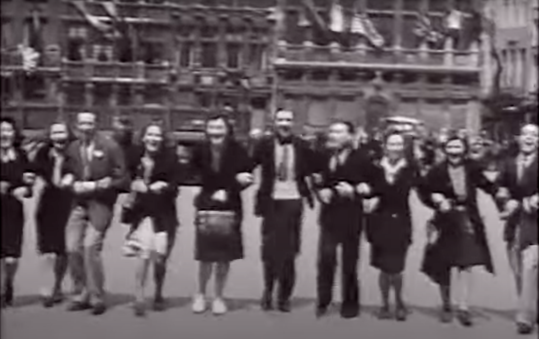
Celebrations in Brussels' Grand Place (from Paul Castaing's film)

Royal Family and Winston on the balcony at Buckingham Palace
Hitler ‘funeral’
Residents in the Marolles neighbourhood of Brussels held a mock funeral procession for Adolf Hitler on 10 June 1945. A local man dressed as the German leader, who had committed suicide ten days earlier.

The mock funeral

Plaque in Rue Haute (author)
Citizen Dwight
General Dwight D. Eisenhower, Supreme Commander of the Allied Expeditionary Force in Europe, was made an honorary citizen of Brussels during a visit on 6 September 1945. He was decorated with the Grand Cordon of the Ordre de Léopold, while his chief of staff General Walter Bedell Smith received the Grand Cordon of the Ordre de la Couronne. Major-General Sir Edward Spears represented Britain at the ceremonies. The same day Japanese forces in southwest Asia surrendered aboard the British aircraft carrier HMS Glory at Rabaul.
La Bal de La Victoire
Members took part in the spectacular Bal de La Victoire in Brussels on 8 September 1945. A huge outdoor dance floor was laid in the Place de la Monnaie, with thousands of “indefatigable” couples dancing the night away. Organised by La Dernière Heure and Le Soir, the event was hosted by Captain Richard Evans of the BBC and Marcel Antoine, a cabaret artist from Radio-Schaerbeek. Live music was provided by Yvon de Bie and his all-Belgian Band, the US 433rd Army Services Dance Band, US 107th Army Ground Forces Band, British Lowlanders Dance Band, and Bobby Naret and his orchestra. Detachments from the Armoured Guards Division, US 101st Airborne Division, Division Leclerc, Brigade Piron and 52nd (Lowland) Division were cheered by the crowd.

Coverage of La Bal de la Victoire (Le Soir)
Citizen Monty
Field Marshal Bernard Montgomery returned to Belgium on 12 September 1945 to be made an honorary citizen of Brussels and receive the Grand Cordon of the Ordre de Léopold. Branch members joined Prime Minister Achille Van Acker, Ambassador Sir Hughe Montgomery Knatchbull-Hugessen, his wife Lady Mary, and military personnel at the citizenship investiture in the Gothic Hall of the Hôtel de Ville. Monty earlier paid his respects at the Tomb of the Unknown Soldier with Achille Van Acker and Education Minister Auguste Buisseret.

Monty salutes the Unknown Soldier, flanked by Prime Minister Achille
Van Acker (right) and Education Minister Auguste Buisseret (La Libre Belgique)
Old soldiers never die!
La Dernière Heure and La Nation Belge covered a reception on 25 September 1945 to mark the first anniversary of the re-formation of Brussels branch. The event was hosted by Chair Léon Gyssels, Vice-Chair Captain J.F. Davis and Captain Drummond-Murray. Also present were Général René-Henri Willems, Arthur Aveling CBE, chargé d’affaires, Major S. Stevenson, representing Brigadier Gerald Tarleton DSO MC of the British Garrison, and Belgian veterans’ federations. The toast was “old soldiers never die!” In the same issue, La Nation Belge reported that police had arrested around 20 Belgian former members of the Waffen SS and Légion Wallonie after they were caught using false identity papers in Brussels.
Guards return
The Guards Armoured Division returned to Brussels on 28 September 1945 to take part in a victory parade (film footage). Major General Allan Adair laid a wreath at the Tomb of the Unknown Soldier. A ceremony followed at Place Poelaert in the presence of Queen Elisabeth of the Belgians and Ambassador Sir Hughe Montgomery Knatchbull-Hugessen. Brussels burgomaster Frédéric Van de Meulebroek presented standards to the Welsh Guards, Grenadier Guards, Irish Guards, Scots Guards, Coldstream Guards and Household Cavalry. Regimental Sergeant Major Ivor Roberts of the Welsh Guards presented a uniform for the Manneken-Pis.

RSM Ivor Roberts dresses the Manneken Pis in a Welsh Guards uniform
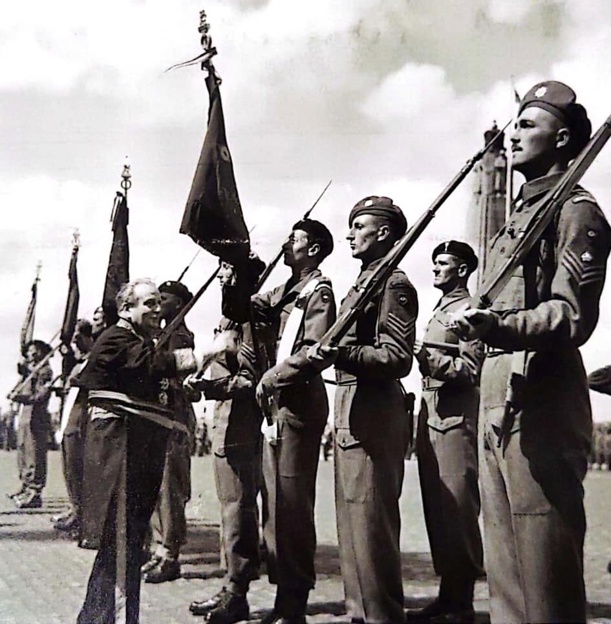
Frédéric Van de Meulebroek presents standard to the Welsh Guards

Standard presented to the Household Cavalry
Belgian colours
Chair Léon Gyssels was presented with a Belgian flag by Colonel Louis Louveau, President of the UFAC (Union des Fraternelles de l’Armée de Campagne), at the Remembrance Day ceremony at the British Memorial in Rue des Quatre Bras on 11 November 1945. The flag replaced one removed from the branch HQ by German troops during the occupation.

British Memorial in Rue des Quatre Bras (Rainer Hiltermann)
Winston in Brussels
Winston Churchill and his daughter Mary visited Brussels on 15-16 November 1945. Newspapers reported how the city came to a standstill: everyone wanted to cheer the wartime leader. Churchill, who also visited Antwerp, lost his premiership after Clement Attlee’s Labour Party swept to a landslide victory on 5 July with a manifesto promising post-war recovery.

Churchill on the cover of a Belgian magazine

Laying a wreath at the Tomb of the Unknown Soldier
The caption reads: 'The most known pays homage to the unknown'

