Welcome to the Brussels Branch of The Royal British Legion


Autumn 2026
Dear friends,
Who would you describe as the “face” of an RBL branch?
Tempting as it is to suggest the Chair – modesty aside – there’s really no contest. It’s always the Standard Bearer.
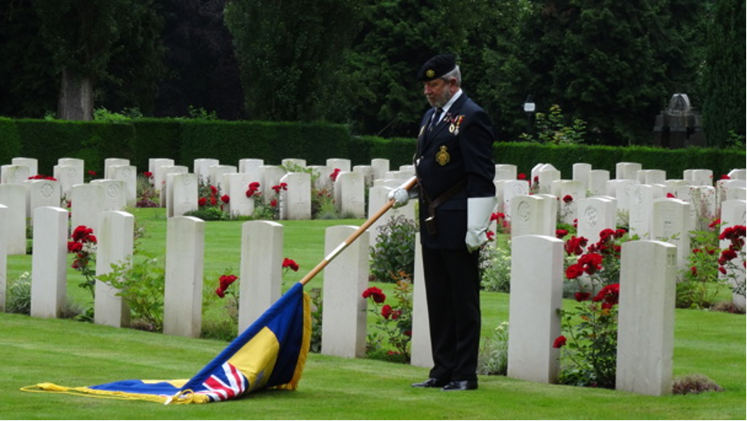
At Brussels branch, we have an absolute gem in Freddy Roiseux.
For those who don’t know him personally, Freddy epitomises the highest standards of the Legion. His turnout and drill are never less than immaculate. Once his duty is done, he’s rarely without a smile, especially if there’s a whisky close at hand.
Freddy, who turns 80 in October 2026, took over as Standard Bearer in 2012, when the legendary Eric Johnson BEM encouraged him to be his successor.
Eric knew Freddy was a natural for the job: he was anything but green, with more than three decades of service to organisations linked with British veterans.
In 1980 he was appointed Standard Bearer for the Comet Line Remembrance Association – commemorating the courage of the Second World War secret escape network which helped hundreds of stranded Allied aircrew and servicemen to make “home runs” from occupied Belgium and France.
He carried the Comète flag at the funeral last year of wartime Resistance heroine Andrée (Nadine) Dumon, the last of a unique generation.
From 1987-2016, Freddy was also the Standard Bearer for the Korean War veterans (Brabant branch) and from 1998-2012 he served as Standard Bearer for the UK Royal Naval Association in Belgium (both branches, alas, now dissolved).
But the RBL has long been his priority.
In addition to taking a lead role in the branch’s three main annual commemorations at Evere, Hotton and Heverlee, Freddy carries the Legion Standard at numerous other ceremonies in Belgium.
He has also been the face of the branch at high-profile occasions attended by members of the Belgian and British Royal Families. He was selected to be in the guard of honour in the presence of King Philippe, Queen Mathilde, Prince William and Princess Catherine at Saint Symphorien cemetery on 4 August 2014, at an event to mark the 100th anniversary of the start of the First World War.
Freddy did his military service in the Belgian Navy from 2 November 1964 until 31 January 1966. “Baby Love” by The Supremes and “(There's) Always Something There to Remind Me” by Sandie Shaw were lighting up the charts when he started; by the time he left to begin a career as a plumber, “The Sound of Silence” by Simon & Garfunkel and “We Can Work It Out” by The Beatles were top of the pops.
Like Freddy, they’ve stood the test of time.
After a year in the plumbing trade, Freddy moved to Electrogaz and then to Engie, where he spent the rest of his career before retiring.
Freddy’s service to the RBL and British veterans is, and has been, exceptional. He lives a fair distance from Brussels at Eghezée in Wallonia, which means long drives to attend most ceremonies and meetings. He literally goes the extra mile (or kilometre) for us.
Freddy, who lost his beloved wife Elvire in 2024, is greatly appreciated by the branch committee and members. He has recently been recuperating after illness and everyone hopes he will soon be back on his feet.
If you see him at a commemoration, have a word; you’re bound to get a smile and, if your French is better than mine, a proper conversation.
Thank you, Freddy, for all you do for the branch.
Freddy’s big day is not the only milestone we will be celebrating.
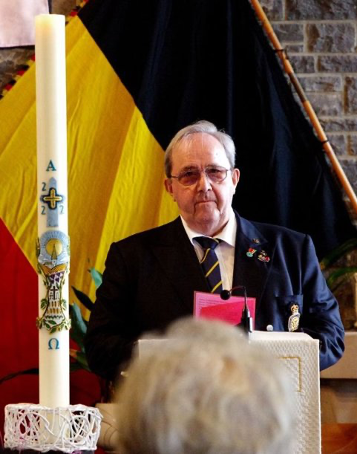
Another branch hero with a special birthday in October is Jean-Pierre Pede, who will also celebrate his 80th.
J-P (pictured above) has been an enthusiastic supporter of the branch since the 1970s. He was first encouraged to get involved by his father-in-law, Harry Moffatt, a Normandy veteran who took part in the liberation of Brussels.
In 2013, J-P joined the committee as First World War Centenary Coordinator. He has since served as Membership Secretary and Treasurer before becoming Vice-Chair.
He was presented with a certificate of appreciation by HRH Princess Claire at our Gala Dinner on the 80th anniversary of the liberation in September 2024. The RBL awarded him its coveted Gold Badge soon after.
***
When I’m travelling and tell people about the RBL and Belgium in general, it’s surprising how often it can trigger a connection.

A case in point is an encounter I had with Geoff Clegg, a 92-year-old fell runner, while visiting my mum over the summer in North Wales. We were introduced by Craig Jones, a family friend, at a 5km park run in Conwy, where they are pictured.
Geoff, easing his way back to fitness after an illness, decided to walk the route, albeit in record time for his age group.
When we chatted afterwards, he mentioned that he’d done his military service in Belgium in the early 1950s.
I was a bit sceptical at first and asked where he was based. “Liège”, he replied, before correcting himself. “I mean Lier.”
For those who don’t know, Lier is a pretty Flemish town located in the province of Antwerp.
So why on earth were British national servicemen posted to Belgium?
Geoff shrugged. All he could remember was that he was sent to a Belgian barracks. He was more interested in telling me how he had fallen for a cracking Belgian woman in Lier. “I should have married her. She was beautiful,” he sighed.
He’s a widower, so there can be no complaints from the lady he actually ended up marrying.
But we digress.
I did a bit of digging and discovered that in 1952 Britain and Belgium signed an agreement which established “Operation Gondola”. It aimed to set up military bases and supply depots in the northern Kempen countryside. It was the height of the Cold War and the UK needed bases close to the port of Antwerp to supply the British Army of the Rhine in case of a Soviet attack.
This agreement envisaged four camps to accommodate British soldiers at Emblem, Grobbendonk, Westerlo and Tielen, as well as equipment depots in Berlaar, Boechout, Broechem, Herentals, Lier, Noorderwijk, Olen, Tongerloo, Geel and Tielen.
The news of British bases did not go down too well with the local menfolk, according to Belgian historian Dr Peter Schrijvers; they feared “unfair marriage-market competition” and warned that young women would face the advances of “inebriated Tommies”. An outrageous slur!
Following the fall of the Berlin Wall in 1989, all the camps were transferred to the Belgian Ministry of Defence in 1992.
***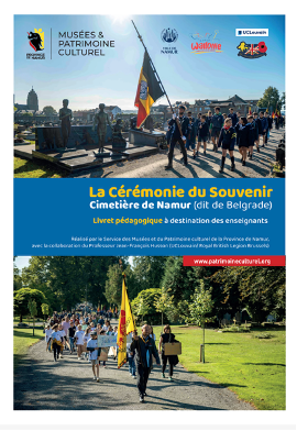 And, finally, congratulations to committee member Jean-François Husson, joint author of La Cérémonie du Souvenir Cimetière de Namur. It’s a beautifully illustrated teachers’ guide, produced with the Museums and Cultural Heritage Department of the Province of Namur (le Service des Musées et du Patrimoine culturel de la Province de Namur). The 32-page brochure, in French, tells the story of Namur (Belgrade) cemetery, explains why it is important for youngsters to actively participate in remembrance events and how they can find out more about the people named on war memorials in their town or village.
It profiles heroes linked with Namur and the Belgian Resistance such as François Bovesse, a minister killed by Rexist collaborators, Arthur Georges, a curate who died in captivity, and Suzanne Mélot, who paid with her life for helping Allied airmen escape. It also spotlights First World War nurse Elsie Gladstone and Lieutenant James Turner of the Royal Flying Corps, killed during an attack on the German Zeppelin base at Cognelée. The booklet also recalls the tragic results of an American bombing raid on 18 August 1944, which left at least 330 civilians dead and over 600 others seriously injured.
It’s a brilliant project and let’s hope it will inspire other Belgian authorities to produce similar guides.
My huge thanks to Michael (Whitburn) and Filo for putting together the latest edition of The Wipers Times. You can read it online, along with previous editions going back until 1999, here:
https://branches.britishlegion.org.uk/branches/brussels-branch/the-wipers-times/
Well, that’s all, folks. Until next time.
Dennis
[email protected]