
Queen Mary and Belgian Queen Elisabeth with Earl Haig, the Legion's first
President, during the State Visit in May 1922 (Rainer Hiltermann collection)
Founding of the Brussels branch
After the First World War, the British community rapidly expanded in booming Brussels. Belgian daily Le Soir reported that “more than 300 subjects of King George who had served in the Great War” were living in the city in 1922.
King George V and Queen Mary, accompanied by Princess Alice, Field Marshal Earl Haig and Admiral of the Fleet Earl Beatty, paid a State visit to the Belgian capital from 8-11 May 1922. Huge crowds greeted the Royal party in what The Times described as a “long roar of welcome”.
Inspired by the Royal visit and the launch of Legion branches in Antwerp and Paris, a group of serving British officers including Major Victor Saxon, Captain (later Major) Horace Field Westmacott, Captain J. Robson, Captain Needham, Captain Butler and Captain Gladwin Baillie formed Brussels branch on 17 May 1922. Belgian daily La Dernière Heure carried a notice about the first meeting.
Captain Westmacott, a military intelligence officer at the British Embassy, was elected as the branch’s first Chair. He had served with the Queens Own (Royal West Kent) Regiment in the First World War, sustaining a serious wound at Hill 60 during the Second Battle of Ypres. He met his Belgian-born wife Andrée Gavage while recovering in Switzerland.
He came from a military family. His father Lieutenant Colonel Ruscombe F. Westmacott (1848-1925) was aide-de-camp to Major General Sir Henry Clifford VC in the Zulu War. His uncle was Major General Sir Richard Westmacott KCB DSO (1841-1925). The grandson of our founding Chairman, Sir Peter Westmacott GCMG LVO, served as Vice-President in the branch’s centenary year.
Major Saxon, elected Vice-Chair, was mentioned in despatches by Earl Haig during his service as a private with the 28th (County of London) Battalion (Artists Rifles) and later commissioned into the 2/1st Kent Cyclist Battalion. Captain Robson was the first branch secretary and Captain Butler its first treasurer.
In 1922, the British Legion expanded in Britain and overseas at the rate of nearly two branches a day, finishing the year with 2,089 branches.

Notice about branch's first meeting (La Dernière Heure)
 H.F. Westmacott, the first Chair (La Nation Belge)
 Members at Tomb of the Unknown Soldier on 3 November 1923 (Le Soir)
Cross of Sacrifice unveiled
Vice-Chair Major Victor Saxon and Captain Needham represented the branch at the unveiling of the Cross of Sacrifice at Mons cemetery on 28 May 1922. A large crowd attended the ceremony. Among the VIPs present were Sir Reginald Wingate, former Governor-General of the Sudan and High Commissioner of Egypt, Sir Frederic Kenyon, Director of the British Museum, Major Arthur Ingpen, Imperial War Graves Commission Land and Legal Adviser in France and Belgium, Fulgence Masson, Belgian Minister of Justice, and Jean Lescarts, Mayor of Mons.

Lieutenant (later Major) Victor Saxon, first left, with the Kent Cyclist Battalion
VIP visitors
The branch’s first meetings were held at the Old Tom Tavern in Chaussée d’Ixelles. The Legion’s first National General Secretary, Lieutenant Colonel Edward Charles Heath DSO, who commanded the 3rd Battalion Sherwood Foresters and 8th Battalion Liverpool Regiment (Liverpool Irish) during the First World War, addressed members at the tavern on 14 August 1922. National Vice-President Colonel George R. Crosfield DSO TD, who also took part, commanded the 14th South Lancashire Regiment, 2nd Suffolk Regiment and 10th Royal Welsh Fusiliers in the war. Despite losing a leg at the Battle of St Eloi Craters near Ypres, he went on to command the 7th Reserve Battalion of the King’s Liverpool Regiment before being commissioned as an observer in the Royal Air Force in 1918. The meeting was followed by a concert.

Sign at the Old Tom Tavern where the branch first met

George R. Crosfield, National Vice-President
Plea for unemployed
The Times in London reported on 31 August 1922 that Legion branches in Brussels, Antwerp and Paris were teaming up with Embassy officials and influential members to find jobs for unemployed ex-servicemen. “The melancholy fact remains that the demand far exceeds the supply,” the report noted. It cited Legion General Secretary Edward Heath, just back from visiting branches in Belgium and France, who urged more ex-officers to support the charity “to share the joys and sorrows of the men with whom they were in such close touch in the days of the war”. Colonel Heath, who designed the first Legion standard, also expressed concern over the Legion’s finances. “The public are extraordinarily generous on great occasions, such as November 11,” he said, “but we require a steady income … if we are to accomplish all we have in mind.” One of his concerns was the number of ex-servicemen suffering from tuberculosis.
Banking on a result
The branch had its own football team. La Nation Belge reported on its upcoming fixtures against La Banque Belge pour L’Etranger (described as a “good team”) at FC La Roue Brussels on 16 September 1922 and, the following week, against Banque d’Outremer at Ixelles Sporting Club.
Tribute to Edith Cavell
The branch was represented at the unveiling of a plaque commemorating nurse Edith Cavell at Christ Church (now Holy Trinity) in Brussels' Rue Crespel on 26 October 1922. Among those present at the ceremony were British Ambassador Sir George Grahame, Military Attaché Colonel Francis Lyon CB CMG CVO DSO, and George Potts, Chair of the British Chamber of Commerce in Belgium, who paid tribute to Cavell’s courage during the war. He noted that she was treating a German officer when she was arrested. Cavell admitted helping allied troops to cross into neutral Netherlands and was executed in Schaerbeek on 12 October 1915.
Burial of the Unknown Soldier
Some 25 uniformed branch members, under the orders of Major V.D.J. Saxon, took part in an immense commemoration to mark the burial of the Unknown Soldier (Soldat Inconnu) in Brussels on 11 November 1922 (film footage).
Crowds lined the route of the funeral procession, from Gare du Nord to the Colonne du Congrès. King Albert I, Prince Léopold and Prince Charles accompanied the catafalque carrying the Unknown Soldier’s coffin, followed by hundreds of allied troops, ambassadors, senators, deputies, nurses and others.
The King, joined at the Colonne du Congrès by Queen Elisabeth and Princess Marie-José, placed the Cross of the Order of Léopold and Croix de Guerre on the casket. Field Marshal John French, 1st Earl of Ypres, Commander-in-Chief of the British Expeditionary Force (BEF), Général Jean-Marie Degoutte, commander of the Sixth French Army, General Henry Allen, commander of the US 90th Infantry Division, and General Guglielmo Pecori Giraldi, commander of the Italian 1st Army, represented the allied forces.
After the ceremony, British Ambassador Sir George Grahame hosted a banquet in honour of Field Marshal French and Sir Richard Squires, Prime Minister of Newfoundland.
The Unknown Soldier was selected from coffins containing the remains of five unidentified soldiers from different battle sites. The coffins were taken to Bruges railway station where Reinold ‘Raymond’ Haesebrouck, a veteran blinded by shrapnel during the Battle of the Yser, placed a crown of laurel on one of the caskets. The selected coffin was then taken by rail to Brussels, watched by crowds along the route. Haesebrouck is said to have saved the life of Albert I when he threw himself on the King when a trench he was visiting came under fire. Haesebrouck died on 25 August 1951 in Assebroek, a suburb of Bruges. A park in the city was named after him in 2020.
 British contingent marches in the funeral procession on 11 November 1922
 The Belgian Royal Family salutes the Unknown Soldier (le Soldat Inconnu)
First headquarters
On 2 December 1922, the branch opened its first premises at 13 Rue du Berger, Ixelles, with a lunch reception attended by Ambassador and Honorary President Sir George Grahame, the tallest man in the Diplomatic Service. Guests included Adolphe Buyl, Mayor of Ixelles, Colonel Francis Lyon, British Military Attaché, Commandant Edmond Massol, French Air Attaché, Captain Rogers, representing the United States, Colonel Maltese, Italian Military Attaché, George Vaxelaire, Polish Consul-General, and Lieutenant Colonel L. Aerts of the Ypres League and later assistant director of the Ecole Royale Militaire. The Ambassador wished the branch “long life and prosperity” while the members responded with three cheers and “For He’s A Jolly Good Fellow”. Le Soir reported that the inauguration was “simple, rapid and cordial, as all English ceremonies”. In the evening the branch held what it called a “smoking concert”.


Branch Vice-President Colonel Henry Needham,
and as portrayed by Le Vingtième Siècle
Vice-President Henry
La Libre Belgique reported on 13 January 1923 that Ambassador Sir George Grahame presented new Military Attaché Colonel Henry Needham CMG DSO to King Albert. Needham was appointed Vice-President of the branch soon after. Colonel (later Major-General) Needham had a long and distinguished military career. He served in the Boer War in 1899-1900, on the Western Front in 1914-15, with the 28th Division in Salonika and with IX Corps in Egypt. He was attached to the American Staff College at Langres, France, from June to September 1918, and with the North Russian Expeditionary Force based at Murmansk and Archangel from September 1918 to October 1919. He was commanding officer of the 4th Battalion, Worcester Regiment between 1921 and 1922. Colonel Needham also served as Military Attaché to Paris between 1927 and 1931. He later served as Major-General of Bombay District between 1931-35 and liaison officer with the Belgian Army in 1940. He was wounded during the Second World War. He died in 1965, aged 89.
La Fête de la British Légion
In an article titled ‘La Fête de la British Légion’, Le Soir reported on the “extraordinary success” of a performance of The Rest Cure by Gertrude E. Jennings, and Billeted by Fryn Tennyson Jesse and Harold Harwood, at the Théâtre du Marais on 5 February 1923. The cast, composed of members and supporters of the branch, gave a show “worthy of great artists”, according to the paper. The cast included Mrs J.F. Turner, Mrs V.D.J. Saxon, Miss Billie Webb, Miss Murielle Langley, Miss Joy Clayton, Mrs Graham, Captain Charles Graham, Major V.D.J. Saxon, Captain C.G. Graves and Mr E.E. Bale. Among the audience were Lieutenant Général Count André de Jonghe d’Ardoye, representing King Albert, Adolphe Buyl, Mayor of Ixelles, Fernand Demets, Mayor of Anderlecht, and Colonel Henry Needham.
Visit of The Prince of Wales
The Prince of Wales and future Edward VIII met branch members during a visit to Brussels on 28 April 1923. By all accounts, it was an unforgettable occasion.
After earlier unveiling the British Memorial (Monument de la reconnaissance britannique) in Rue des Quatre Bras and laying a wreath at the Tomb of the Unknown Soldier, the Prince visited the Hôtel de Ville before arriving at the branch HQ in Rue du Berger at 3.40pm. He was accompanied by Field Marshal Earl Haig, Rear-Admiral Sir Lionel Helsey, Ambassador Sir George Grahame, and Lieutenant Général Count André de Jonghe d’Ardoye.
In the words of The Times, the Prince was “a comrade among comrades” and “tumultuously greeted in a big room cosy with tobacco smoke”.
Welcomed by branch President Henry Needham and Chair H.F. Westmacott, the Prince was introduced to the committee and then greeted each of the 200 members present with a “vigorous handshake”, according to reports. They responded with “Hip Hip Hurrah” and “For He’s A Jolly Good Fellow”. Seeing photographers present, the Prince gathered the members around him to capture the moment.
Earl Haig struck up a conversation with a veteran wearing the Victoria Cross, Britain's highest distinction for bravery. “I am proud to be able to shake your hand,” said the Field Marshal, who was one of the founders of the British Legion and its President until his death in 1928.
Among the other dignitaries present were Adolphe Buyl, Mayor of Ixelles, Fernand Demets, Mayor of Anderlecht and President of the Amicale des Officiers Belges, Commandant Massol, French Air Attaché, and Captain Count Bernard de La Forest Divonne.
The Journal De Bruxelles described the Royal reception as “a triumph that the Prince would remember for a long time and that the members of the British Legion would talk about for the rest of their lives”.
After the visit, the Prince of Wales took tea with Prince Victor Napoleon and his wife Princess Clémentine of Belgium, before attending a Royal banquet at the Palace hosted by King Albert and Queen Elisabeth. He left Brussels the following morning for a visit to the battlefields around Ypres.

The Prince of Wales and Field Marshal Haig meeting branch members on 28 April 1923

The Prince salutes at the British Memorial

The Prince lays a wreath at theTomb of the Unknown Soldier
(Rainer Hiltermann collection)
Focus of British life
The Prince of Wales highlighted his visit to Belgium in a speech at the annual conference of the British Legion in London on 20 May 1923. He commented: “Recently with Lord Haig I have visited a branch of the Legion in Brussels and since then I have realised the fact that our branches in the big foreign cities are fast becoming the focus of British life and enterprise.”
Koekelberg tribute
Major Coopman-Laurent represented the Legion at the inauguration of a bronze sculpture by Pierre de Soete at the maison communale in Koekelberg on 22 July 1923. It commemorated the 75 local inhabitants who lost their lives during the First World War. Prince Léopold and Lieutenant Général Count André de Jonghe d’Ardoye were among VIPs at the ceremony.
FIDAC congress
Chair H.F. Westmacott attended the second annual congress of FIDAC (Fédération Interalliée Des Anciens Combattants / Interallied Veterans’ Federation), which took place in Brussels from 1-8 September 1923. The British delegation, led by Colonel George R. Crosfield, National Vice-President of the Legion and Vice-President of FIDAC, also included Major General Arthur Sandbach, Liverpool MP Major Brunel Cohen and Captain William Appleby, a member of the national executive committee left blind from his injuries during the war. Cohen, severely wounded at the Third Battle of Ypres (Battle of Passchendaele), served as the Legion’s national Honorary Treasurer from 1921-30, Vice-Chairman from 1930-1932, and again as Honorary Treasurer until 1946.
30 million poppies
A report on 17 October 1923 in Le Soir stated that the Legion was expecting to sell 30 million poppies ahead of the Armistice anniversary in Britain in aid of war invalids and veterans.
Journée de la Reconnaissance
Members took part in a commemoration at the Tomb of the Unknown Soldier to mark Armistice Day on 11 November 1923. 15,000 disabled ex-servicemen from all over Belgium were present. Adolphe Max, Mayor of Brussels, urged citizens to show gratitude for their sacrifice by welcoming the men to their tables as part of the “Journée de la Reconnaissance”.
Comedy fund-raiser
The English Comedy Club gave a performance of the James Montgomery play Nothing But the Truth on 7 December 1923 at the Théâtre Communal in rue de Laeken. The show, much appreciated by an audience which included the Ambassadors of Britain and Spain, raised funds for the branch and the Victoria Institute.
What Every Woman Knows
The branch organised a performance of J.M. Barrie’s play What Every Woman Knows at the Théâtre du Marais on 3 March 1924. Held under the patronage of Queen Elisabeth, the evening raised funds for charitable works by the Queen and the British community. The cast, with Major V.D.J. Saxon in the lead role, included Mrs V.D.J. Saxon, Mary Butler, Marjorie Larkin, Major H. Johnson, John Turner, R. Walker, Captain Taunton and J.B. Murray. The performance ended with a rousing rendition of God Save The King, followed by dancing. Tickets were available from W.H. Smith & Son, 78 rue du Marché aux Herbes, the Westminster Foreign Bank, 2-4 rue Treurenberg, and the British Chamber of Commerce, 440 rue du Trône.
Household Cavalry memorial
Chair H.F. Westmacott represented the branch at the inauguration of the Household Cavalry memorial at Zandvoorde on 4 May 1924. Nearly 300 men from the 1st and 2nd Life Guards, as well as the Horse Guards, fought to the last during a fierce German attack on the village on 30 October 1914. The monument was unveiled by Field Marshal Earl Haig. Baron Léon Janssens de Bisthoven, Governor of West Flanders, Général-Major O. Préaux, Commandant of West Flanders, René Colaert, Mayor of Ypres, and Colonel Henry Needham, Military Attaché and branch President, also attended the ceremony.
Royal Irish tributes
Chair H.F. Westmacott, accompanied by the Chair of Antwerp branch, took part in ceremonies at Mons and Saint Symphorien on 24 August 1924. They also placed wreaths on monuments to the 2nd Battalion Royal Irish Regiment at La Bascule and 5th Royal Irish Lancers at the Hôtel de Ville in Mons.
Graveside guard
The Times reported that Chair H.F. Westmacott laid a “magnificent” wreath at the Tomb of the Unknown Soldier on Armistice Day, 11 November 1924. “Officers who took part in the war mounted guard at the graveside from 7am until 8 in the evening. At 11am, the one minute’s silence was announced by the firing of a gun, and all trains and trams were brought to a standstill,” the report stated. In the evening, the “British colony” gave a ball at the Palais d’Egmont, attended by Ambassador Sir George Grahame.
Royal gala
On 5 March 1925, Belgian King Albert I and Queen Elisabeth attended a gala evening organised by the branch’s drama club at the Théâtre Royal du Parc. The highlight was a performance of Secrete, a play by Rudolf Besier and May Edginton. Prime Minister Georges Theunis attended the second performance on 6 March.
Vive la France
Chair Major H.F. Westmacott represented the branch at a banquet laid on by the Society of French officers in Belgium on 28 March 1925. Toasting his hosts, Westmacott said British officers would always be proud to fight with their French allies. The guests included Colonel (later General and Baron) Victor van Strydonck, who commanded the last cavalry charge in western Europe on 19 October 1918 and formed the Free Belgian Forces in Britain in 1940.
Cercle Gaulois welcomes Irish veterans
Veterans of the 16th (Irish) Division gathered in Brussels on 24 August 1926 after the inauguration of a monument commemorating their capture of Wytschaete during the Battle of Messines in 1917. Chair H.F. Westmacott represented the branch at a reception hosted by Le Cercle Gaulois. The Irish delegation included Colonel Sir Robert Tate, a professor at Trinity College, and Colonel Sir William Taylor CB KBE, chair of the Royal College of Surgeons in Dublin. The Cercle Gaulois, located behind the Théâtre Royal in the royal park, provided accommodation for German troops in Brussels during the First World War. Napoleon and Joséphine were also previous guests.
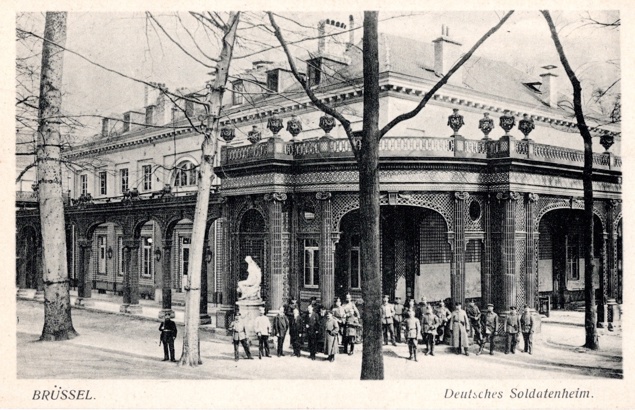
The Cercle Gaulois provided accommodation for German troops
in Brussels during the First World War
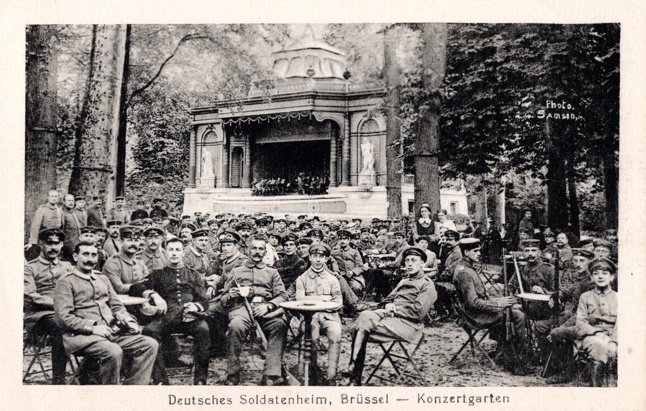
German troops in the royal park (Rainer Hiltermann collection)
Tribute at Cathedral
Field Marshal Earl Haig unveiled a memorial tablet on behalf of the Imperial War Graves Commission at St Michael and St Gudula Cathedral in Brussels on 22 July 1927. The inscription was written by novelist Rudyard Kipling, whose 18-year-old son John was killed at the Battle of Loos. Similar tablets were erected in 28 French and Belgian towns where Empire troops were quartered during the First World War. Mons, Mechelen, Antwerp and Ypres were the other Belgian locations.

Tablet unveiled by Earl Haig (author)
Menin Gate inauguration
The Menin Gate in Ypres (Ieper), commemorating 55,000 British and Commonwealth soldiers lost in western Flanders with no known grave, was inaugurated on 24 July 1927 by Field Marshal Lord Plumer. Albert I and General Ferdinand Foch were among the dignitaries at the ceremony, which was watched by a large contingent of veterans, relatives of the missing and local people. Buglers from the Somerset Light Infantry sounded the Last Post and pipers from the Scots Guards played a lament from the ramparts. General Charles Harington recalled the moving words of his former commander in his book, Plumer of Messines. “He was thinking, as we were, of all those Brigade and Battalion Headquarters which he used to visit, living in burrows under those ramparts, of the casualties incurred nightly by the endless stream of transport – men, their horses and mules – on their nightmare journeys through that Menin Gate, the star shells, the crackling rifle fire, shell bursts, plunging horses and dogged infantrymen. Each gateway a bottle-neck, registered to an inch by the enemy guns. Every man and animal had to run the gauntlet both going in and coming out. The Cloth Hall of world fame. The Cathedral. The Convent. The old Water Tower leaning over like Pisa, and every other building all in ruins, the old swans still swimming in the moat...”
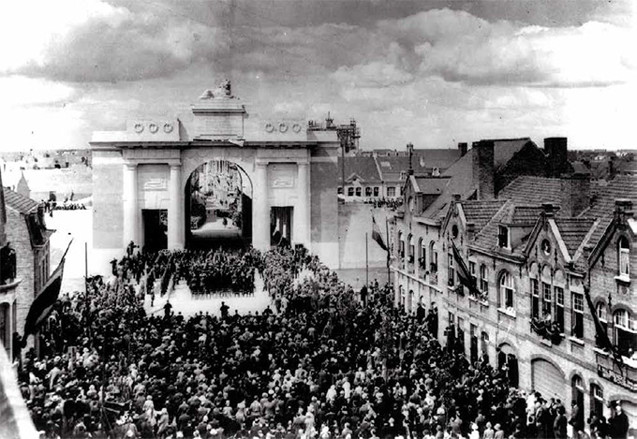
A huge crowd at the Menin Gate inauguration

Field Marshal Lord Plumer takes the salute
To the relatives of the lost, Plumer said: “It was resolved that here at Ypres, where so many of the ‘Missing’ are known to have fallen, there should be erected a memorial worthy of them which should give expression to the nation’s gratitude for their sacrifice and its sympathy with those who mourned them. A memorial has been erected which, in its simple grandeur, fulfils this object, and now it can be said of each one in whose honour we are assembled here today: ‘He is not missing; he is here’.”
Visit of ‘Old Contemptibles’
Chair H.F. Westmacott and Freddy Vandewiele, President of the Fédération Nationale des Combattants (FNC), greeted 225 British veterans at Gare du Nord on 10 November 1927. The group of Old Contemptibles, as members of the British Expeditionary Force were known (Kaiser Wilhelm II described them as a “contemptible little army”), were visiting Belgium for a battlefield pilgrimage. The party included three recipients of the Victoria Cross.
Death of Earl Haig
British Legion President Earl Haig died in London from a heart attack on 29 January 1928. Huge crowds lined the route of his funeral on 3 February. The gun-carriage that had carried the Unknown Warrior in 1920 took Earl Haig’s body from St Columba’s Church to Westminster Abbey. The Prince of Wales, Duke of York Prince Albert (later George VI) and Prince Arthur of Connaught followed the gun-carriage and pall-bearers included Marshal Ferdinand Foch and Marshal Philippe Pétain. Earl Haig was buried at Dryburgh Abbey in the Scottish borders.
Last Post
The first regular sounding of Last Post took place on 1 July 1928 at the Menin Gate in Ypres. Pierre van den Braambussche, chief police commissioner, had the idea for a ceremony every evening and called for volunteers from the fire brigade. A daily ceremony took place initially for four months and was reinstated in spring 1929 when the Brussels and Antwerp branches of the Legion donated four silver bugles.
From 11 November 1929, the Last Post has been sounded every night except during the German occupation in the Second World War. The bugles were replaced in 1992. Eight new bugles were presented to the Last Post Association by the Royal British Legion in July 2007. During the Covid lockdowns in 2020-21, a lone bugler sounded the Last Post.
'The Great Pilgrimage'
Major Brunel Cohen MP, the Legion’s National Treasurer, laid a wreath at the Tomb of the Unknown Soldier in Brussels on 4 August 1928, the anniversary of the German invasion of Belgium in 1914. The commemoration was part of “The Great Pilgrimage”, organised by the Legion and British Empire Service League to enable veterans and widows to visit the battlefields of Flanders and northern France. Cohen described the Brussels ceremony in “The Story of an Epic Pilgrimage”, an original copy of which is held by the Royal Library of Belgium.
The MP and his 25-strong delegation were welcomed by branch members and General Pierret, representing the Minister of National Defence. After a delay due to heavy rain, the procession set off from the Hôtel des Invalides. The band of the 9th Regiment of the Line played La Brabançonne, Gloire aux héros and God Save The King on muted instruments.
At the Tomb, Major Cohen said: “I place this wreath as a tribute to the glorious dead of Belgium, from the ex-servicemen of Great Britain, the British Legion. So long as this monument stands, their memory will live. So long as the power of speech remains, their heroism shall be told. So long as history is written, their fortitude shall be recorded. Those whose bodies lie on the field of battle, and whose memories will be kept ever green here, have joined that band of immortals, who, placing sacrifice before self, consider themselves well paid in having an opportunity to die for their country.”
Cohen said the visit reaffirmed the friendship which had always existed with Belgium but presciently warned that "in certain parts of Europe the flame of war is by no means extinguished”.
Members of the delegation included representatives from the UK, Australia, New Zealand, Canada and South Africa. Major General Sir William Hickie KCB, commander of the 16th (Irish) Division on the Western Front, Dame Florence Simpson DBE, the senior female British officer during the war, Corporal Arthur Hutt VC, Robert Scott VC, Alfred Dobell DCM MM, Captain R.A. Taunton MC VD, late 27th Winnipeg Battalion, were also present. Hughe Montgomery Knatchbull-Hugessen, counsellor – and future Ambassador to Belgium – represented the British Embassy.

Major Cohen lays a wreath at the Tomb of the Unknown Soldier

Commemorative book produced by the Legion
Prince at Menin Gate
A grand remembrance ceremony was held at the Menin Gate on 8 August 1928 at the end of “The Great Pilgrimage”. The commemorations began with the laying of a wreath by the Prince of Wales, followed by a service led by the Most Reverend Cosmo Lang, Archbishop of York, and Dr Alfred Jarvis, Chaplain-General to the British Army. Some 11,000 veterans and widows took part in the march-past. They were reviewed by Earl Jellicoe, the former Admiral of the Fleet who succeeded Earl Haig as Legion President, Marshal Philippe Pétain, Prince Charles of Belgium, Lady Dorothy Maud ‘Doris’ Haig, and Major-General Sir Frederick Maurice (President of the Legion from 1932 to 1947). Colonel George R. Crosfield, National Chair of the Legion, re-lit the flame of remembrance at the Arc de Triomphe in Paris.
The Prince of Wales sent a letter to the Legion on 10 August, stating that it had “every right to be proud of its pilgrimage which had proved to be such a great success”.

Prince's message to the Legion's 'pilgrims'
Lord Mayor’s visit
Lord Mayor of London Sir Charles Batho laid flowers at the Tomb of the Unknown Soldier and British Memorial during a visit to Brussels by business leaders on 23 August 1928. The party also stopped at the Cathedral to see the tablet commemorating Britain’s war dead (see 22 July 1927). The branch was represented at a dinner hosted by Brussels Mayor Adolphe Max in the Gothic Hall of the Hôtel de Ville. Among the guests were Belgium’s Minister of Foreign Affairs Paul Hymans, Ambassador to the UK Baron Emile de Cartier de Marchienne, and the British Ambassador to Belgium Sir George Grahame.
Legion backs Mémorial Interallié
A British Legion delegation of 48 disabled ex-servicemen visited Belgium from 4-8 September 1928. Led by Colonel John Brown CBE DSO, who served as Chair of the British Legion from 1930-34, the group visited Antwerp, Liège, Loncin, Namur, Spa, Verviers and Brussels. They were honoured in every town, garlanded with flowers by children and moved by the welcome they received. In Liège, Col Brown took part in an earth-digging ceremony on 6 September at the site of the future Mémorial Interallié, built with the support of donations from allied countries. “This is a supreme honour for the British Legion,” he declared.
The veterans, hosted by branch members, attended a reception at the Royal Palace on 7 September with Chargé d’Affaires Sir Hughe Knatchbull-Hugessen and Military Attaché Lieutenant Colonel Cyril Daubney. They were photographed with King Albert and Queen Elisabeth, together with their daughter Princess Marie-José, who was educated in Britain and later became the last Queen of Italy. Adolphe Max, Mayor of Brussels, hosted a lunch at the Hôtel de Ville.
The following day, Princess Marie-Louise de Mérode, known as “la maman des invalides de guerre” and chair of the committee responsible for the Mémorial Interallié and its adjoining church, presided over a lunch at the Laiterie in Bois de Cambre. She paid tribute to the men’s patriotism and energy. Captain Shaw thanked the Princess and, amid applause, pinned the insignia of the British Legion to her dress and presented another insignia to Lieutenant Léon Heusschen, a Belgian wartime amputee. The group were later invited to a garden party at the Lion Mound on the battlefield of Waterloo.
The church next to the Mémorial Interallié in Liège would become the centre of controversy in March 2023 over plans to turn it into a restaurant and climbing club.

Colonel Brown and Legion members at earth-digging ceremony

Brown in uniform

Artists' impression of the future Mémorial Interallié

Legion members with King Albert, Queen Elisabeth and Princess Marie-José
(Le Soir, La Meuse)
Barman wanted
On 14 March 1929 Le Soir carried an advertisement from the branch for a barman at its headquarters (“connaissance anglaise nécessaire”), with references to be sent to L.R. Gyssels, 100 ave Ducpétiaux. Léon Gyssels MC, who served with the 28th County of London Battalion (Artists’ Rifles) in the First World War, later became the branch Chair.

Advert in Le Soir
George sets forth
New Chair Captain George Henry Menhinick RNVR represented the branch at the first annual meeting of the commercial circle of ex-officers on 7 December 1929. L’Indépendance Belge commented that the spirit of comradeship among the former officers was evident to all at the event held at the garrison mess. Menhinick was the director of a clothing firm, Storey Frères, which was seized by the German authorities due its “enemy and Jewish” character in 1940. He was a leading member of the Brussels Yacht Club for many years.
Wedding gift
Legion members sent a silver-framed photograph to Princess Marie-José as a wedding gift following her marriage to Crown Prince Umberto of Italy on 8 January 1930. The photograph was a memento of their September 1928 meeting with the Princess. Marie-José, the last Queen of Italy, died on 27 January 2001, aged 94.

Photo (left) sent to Princess Marie-José

Her wedding to Prince Umberto
Mac in charge
Captain William Wilson MacKeown, who served in the 4th Battalion of the Royal Munster Fusiliers in the First World War, took over as Chair in 1930. He represented the branch at the second annual meeting of the commercial circle of ex-officers on 3 December 1930. Among those at the event, hosted by Henri de Saedeleer, were Lieutenant General Baron Herman Baltia and Roger Marie d’Avigneau, Secretary-General of FIDAC.
Royal Charter
The Brussels branch was incorporated as a non-profit association by Belgian Royal Charter (No. 0408.497.187) on 26 August 1931.
The official document was signed by new branch President Lieutenant Colonel Charles Levenax Haldane CMG DSO, former commanding officer of the 2nd Battalion, 7th Gurkha Rifles, George Menhinick, ex-branch Chair, Ernest Cuthbert, newsagent, and James Edward Watson, accountant.
Haldane was awarded the CMG (Companionship of the Most Distinguished Order of Saint Michael and Saint George) for leading a lightning raid against Turkish forces at Tor on the Sinai Peninsula on 12 February 1915. The Turks lost nearly 100 men in the dawn attack and Haldane’s men returned with more than 100 prisoners and 20 camels. His war record was blemished, however, by a costly defeat at the first Battle of Ramadi (8-13 July 1917) during the Mesopotamian campaign in what is now Iraq.
Ex-officers’ meeting
Charles Haldane represented the branch at the annual meeting of the commercial circle of ex-officers on 2 December 1931. The attendees included Count Charles de Romrée de Vichenet, representing the Minister of Foreign Affairs, and Belgian Defence Minister Léon Dens – who was killed in 1940 during the Blitz when the Belgian government in exile was based in London.
UFAC dinner
Major Guy Reyntiens, Chair of UFAC (Union des Fraternelles de l’Armée de Campagne), hosted a veterans’ dinner on 26 December 1931 at the 1st Régiment des Guides officers’ mess in Brussels. The RBL was represented by Lieutenant Colonel Haldane and Major H.F. Westmacott.
King’s tribute
A framed photograph offered to the branch by King Albert was erected at branch headquarters during an event hosted by Lieutenant Colonel Haldane on 23 February 1932. Among those present were General Raoul Pontus, Chair of the Belgian section of FIDAC, and British Military Attaché Major William Fraser DSO MC.

Haig House hosted visitors until the Second World War
Haig House
Haig House in Ypres (Ieper), donated to the Legion by Major Brunel Cohen, opened on 28 April 1932. The Times reported that the MP wished to provide ex-servicemen and their families with a place to stay during battlefield pilgrimages. The house stood in Rue Courte de Thourout (Korte Torhoutstraat). One side was painted with a huge advertisement that read: "British Legion. Visit Haig House Ypres. Corner of Grand Place. For information & "Haig" poppy wreaths. Luncheons, teas, etc. Tel 151 Britlegion Ypres." The Legion paid for a steward and his family to host visitors until the Second World War. The advert, hidden under a billboard for 73 years, was exposed again in 2013 and the then Flemish Minister for Heritage, Geert Bourgeois, had the wall protected. It was repainted in 2020.
Volunteers’ sacrifice
Captain William MacKeown represented the branch at a reception organised by the National Federation of War Volunteers on 3 July 1932 to honour the 13,000 Belgians who fell on the “field of honour”. MacKeown’s speech was greeted with a spontaneous rendition of “God Save The King”.
Amicale 1914-18
The Amicale des officiers de la campagne 1914-18 held their annual Armistice dinner on 11 November 1932, hosted by Count Adrien Vander Burch. Lieutenant Colonel Haldane represented the Legion.
Mars et Mercure
Lieutenant Colonel Haldane was a guest at the annual banquet of the ex-officers’ business association, now known as “Mars et Mercure”, on 7 December 1932.
Anderlecht match
British and Belgian veterans played a keenly contested football match in front of a large crowd at Anderlecht’s stadium on 17 December 1932. A wreath was laid before kick-off in memory of the Anderlecht players who did not return from the war. The game ended in a 2-1 victory for the “home” team. British Ambassador Lord Granville GCMG GCVO PC and Lieutenant Colonel Haldane were among the spectators.
Nurses honoured
Lieutenant Colonel Haldane and Captain MacKeown led a branch delegation at a ceremony in Uccle on 26 March 1933 to honour nursing staff during the First World War. A marble memorial was unveiled at the Institut de Deux Alice by Baron de Rosée, President of the 13th Field Artillery Regiment old comrades' association, and Countess Maria van den Steen de Jehay, who ran the Elisabeth Hospital in Poperinge. Prince Sixtus of Bourbon-Parma and his brother Prince Xavier of Bourbon-Parma, who both served in the Belgian army during the war, were among the dignitaries present. The pair were involved in failed peace talks with their brother-in-law, Austrian Emperor Charles I, in 1917. Xavier also served in the Belgian Army in 1940 and was a pretender to the Spanish throne.
Battlefield sites preserved
Following an appeal by the Legion, the Belgian government agreed to preserve First World War battlefield sites. According to a report in Le Soir on 7 April 1933, the sites would include Essex Farm, the craters left by mines detonated at Wytschaete-Messines, Triangle Farm (Battle of Langemarck) and Ploegsteert Wood, as well pill-boxes, bunkers and other positions where British troops displayed “bravery without equal”.
Free cigarettes
Captain MacKeown represented the branch at a dinner to mark the IX Congrès de Sous-Officiers on 7 May 1933. The guest of honour was Albert Devèze, Minister of Defence. L’Etoile Belge reported that each attendee enjoyed a “Cigarette Laurens” at the end of the banquet.
Stumped
The annual cricket match between the British Legion and Brussels British Sports Club took place at the Royal Racing Club in Uccle on 21 July 1934. We’re stumped for the result!

The British Legion delegation meets Adolf Hitler in Berlin
Legion meets Hitler
The Legion’s role in efforts to promote peace and internationalism in the 1930s received considerable attention. Belgian media reported on a visit to Berlin on 15 July 1935 by National Chair Major (later Brigadier) Francis Fetherston-Godley OBE and a delegation including Colonel George Crosfield, Major Brunel Cohen and Captain Melville A. Hawes. They met Chancellor Adolf Hitler, his deputy Rudolf Hess, head of the Luftwaffe Hermann Göring, SS chief Heinrich Himmler and Reich Ambassador Joachim Van Ribbentrop (video). They also visited Dachau concentration camp. The contacts were endorsed by the Legion’s patron, the Prince of Wales, who told its annual conference: “There could be no more suitable body or organisation of men to stretch forth the hand of friendship to the Germans than we ex-servicemen.” Fetherston-Godley later told the Legion’s Executive Council: “The delegates were in no way concerned with the general methods in force in Germany; such things, being political, were none of their business.”
Return of FIDAC
From 2-5 September 1935 the branch was represented when Brussels again hosted the FIDAC annual veterans’ congress. Following meetings with ex-service organisations in Germany, Austria and Hungary, the British Legion proposed to allow former enemies to join the body and change its name, but this was rejected, with France and Belgium strongly opposed. Instead, the conference voted unanimously for the executive to establish contacts with ex-servicemen of all nations “to assure the peace of the world”. FIDAC hosted an annual shooting contest at the Tir National range in Brussels and erected a memorial in Liège in 1938. The organisation folded after the outbreak of the Second World War but its work was continued by the World Veterans Federation, founded in 1950. The Legion is a member of the WVF.

Sir Esmond Ovey, ice-skating in
Washington DC in 1912 (Library of Congress)
Chair Briscoe and Ovey at Mons
New Chair Captain Ernest-William Briscoe joined Ambassador Sir Esmond Ovey, Field Marshal Lord Milne, former Chief of the Imperial General Staff, and Colonel Frank Higginson, Deputy Controller of the Imperial War Graves Commission in central Europe, at a commemoration in Mons on 3 November 1935. The event was attended by Prince Charles, Count of Flanders, brother of King Leopold III, and Albert Devèze, Belgium’s Minister of Defence.
Death of George V
Branch members and ex-servicemen took part in memorial service at the Anglican Church in Brussels on 2 February 1936 following the death of King George V at Sandringham. Ambassador Sir Esmond Ovey and Lady Marie-Armande Ovey, together with boy scouts and girl guides, also attended the service. The King was succeeded by his eldest son, Edward VIII, who abdicated in December the same year to marry American divorcée Wallis Simpson.
Farewell to Ada Bodart
The branch was strongly represented on 10 February 1936 at the funeral of Ada Bodart, who helped smuggle British soldiers out of Belgium during the First World War. Court-martialed with Edith Cavell and architect Philippe Baucq, Bodart was condemned to death but her sentence was later commuted to penal servitude. Known as the “godmother of the Old Contemptibles”, Bodart portrayed herself in Dawn, a 1928 film featuring Sybil Thorndike as Cavell. Austen Chamberlain, then British foreign minister, felt the film promoted anti-German sentiment and refused to see it, prompting Bodart to return her OBE.
Cabaret night
Chair Ernest-William Briscoe represented the branch at a banquet organised by the Amicale des Anciens Combattants de la Bourse de Bruxelles on 7 November 1936. The dinner, which followed a ceremony at the Tomb of the Unknown Soldier, was held in the headquarters of the UFAC (Union des Fraternelles de l’Armée de Campagne). Entertainment was provided by dancers from the Cabaret Gaity, as well as Mlle Lodilla, M. Bervyl, M. Delhez and Jenny Hienny – a “perfect pianist”, according to La Nation Belge.
Return of ‘Old Contemptibles’
Ernest-William Briscoe and Colonel Dutrieux, commandant of the 1er Régiment of Défense Terrestre contre Aéronefs (anti-aircraft land defence), greeted 36 British veterans at Gare du Nord on 9 November 1936. The “Old Contemptibles” paid their respects at the Tomb of the Unknown Soldier and grave of Ada Bodart in Evere, leaving flowers in memory of Edith Cavell at St Gilles Prison. They were hosted at the British Garrison officers’ mess. A banquet in the veterans’ honour was attended by branch members including Captain Briscoe, Major William Parker Wrathall, Captain Charles Collins and Captain Drew Clifton.
 At the Tomb of the Unknown Soldier (Le Soir)

Veterans with Colonel Dutrieux (La Nation Belge)
Tribute to Marshal
Chair Ernest-William Briscoe was among the guests at a screening of Foch, a film celebrating the French Marshal, on 5 March 1937. The film by Emile Buhot was shown at Le Scala cinema in Place de Brouckère under the patronage of the branch and other veteran associations. Ambassador Sir Esmond Ovey, his French counterpart Jules Laroche, and Lieutenant General Maurice Gillieaux, representing King Léopold III, were in the audience.
Meeting Mussolini
La Libre Belgique reported on a meeting in Rome on 15 April 1937 between Benito Mussolini and the Legion’s National Chair Major Francis Fetherstone-Godley, who urged the Italian leader to overcome strains in the relationship between Britain and its Great War ally.
Welcome Sir Robert
Chair Ernest-William Briscoe was a guest at a dinner on 7 October 1937 hosted by fellow branch member and Chair of the British Chamber of Commerce, William Parker Wrathall, in honour of the new Ambassador to Belgium, Sir Robert Clive.
 Major W.P. Wrathall DSO MC
Julia hosts veterans
Chair Ernest-William Briscoe and William Parker Wrathall led a delegation of branch members welcoming British veterans on a visit to Brussels on 8 November 1937. Julia Lemonnier, widow of Baron Maurice Lemonnier, the former MP and Brussels mayor who was deported to Germany in the First World War, hosted a dinner for the visitors. On 9 November, Sgt Major Larmer, leading the group, laid a poppy wreath at the Tomb of the Unknown Soldier. The party visited the Tir National, site of Edith Cavell’s execution, and the Royal Crypt at Laeken to pay their respects at the tombs of King Albert and Queen Astrid.
Hot shots
The British Legion team won the annual shooting competition at the Tir National for veterans from countries affiliated to FIDAC on 13 November 1937. The American Legion came second, with the Belgium third.
Cercle Royal Gaulois
The branch hosted its traditional visit from members of the Cercle Royal Gaulois on 5 April 1938. The branch was represented by Chair Ernest-William Briscoe, William Parker Wrathall, Charles Battersby (secretary), the Reverend Philip Moore (chaplain), the Reverend F. Devereux and Charles Collins. The visiting delegation was led by Louis Lagasse de Locht, Director-General of the Belgian Ministry of Labour.
Red card for Matthews in Brussels
Efforts to promote peaceful relations with Hitler’s Germany were not restricted to military associations. On 14 May 1938 some 115,000 spectators packed into Berlin’s Olympic Stadium for a friendly between Germany and England. The home team gave the Nazi salute – and the England players followed suit, on the orders of the Football Association and Foreign Office. Stanley Matthews, the Cristiano Ronaldo of his day, later claimed that “all the England players were livid”. England won the match 6-3. During the Second World War, Matthews served in the Royal Air Force. While famously never booked on the pitch, he got the red card from the RAF’s Special Investigation Branch when he was caught trying to sell black market coffee during a visit to Brussels for a friendly in March 1945. He was arrested with team-mate Stan Mortensen, but the matter was kept under wraps until 2010.

England players, in white, give the Nazi salute in Berlin

Stanley Matthews monument in Stoke-on-Trent
(Basher Eyre, Creative Commons)
General at Berchtesgaden
The Brussels media featured extensive coverage of a meeting at Berchtesgaden on 5 August 1938 between Adolf Hitler and General Ian Hamilton, President of the Legion’s Scottish section and former commander of the Mediterranean Expeditionary Force in Gallipoli, who was accompanied by veterans. The mission sought to promote peace among the “brotherhood of the trenches”.
Legion police force
Following the “peace for our time” Munich Agreement on 30 September 1938, allowing Germany to annex the Sudetenland, Prime Minister Neville Chamberlain proposed the creation of a British Legion Volunteer Police Force to help keep peace in the Czech region, where a referendum was due to be held. The 1,000 strong unarmed force, commanded by National Chair Major Sir Francis Fetherston-Godley, was formed on 6 October 1935 but disbanded 10 days later when the referendum was cancelled.
Reception for ‘Old Contemptibles’
Brussels hosted a third visit by veterans from the “Old Contemptibles” on 8-9 November 1938. Chair Ernest-William Briscoe, William Parker Wrathall and the Reverend Moore represented the Legion at a dinner hosted by Major-aviateur Marcel-Louis Marchal and Louis Lagasse de Locht, chair of the reception committee. VIP guests included Princess Marie-Louise de Mérode and Baronne Julia Lemonnier. 9 November 1938 would later be remembered for the infamous Nazi Kristallnacht when scores of Jews were murdered during attacks across Germany.
Russian aid
Chair Ernest-William Briscoe represented the branch at a performance at the Palais des Beaux Arts on 3 December 1938 in aid of the Union des Invalides and disabled Russian veterans in Belgium.
Grenadier Guards
The branch welcomed a 150-strong delegation from the Grenadier Guards Comrades Association on 8 April 1939. The guards, cheered by large crowds and described in Le Soir as “tous de grands et beaux types”, paid their respects at the Tomb of the Unknown Soldier and British memorial, executing the commands “avec la minutie et la précision caractéristique des Tommies”. Lieutenant Colonel Charles Britten MC laid a poppy wreath at the Prince Albert Barracks.
New Chair Major William Parker Wrathall MC DSO, who served with the Royal Highlanders in the First World War, Ernest-William Briscoe, President and former Chair, Lloyd Evans and a Mr Deeks represented the branch. Colonel André Van Sprang, commanding officer of the Belgian 1st Regiment of Grenadiers, hosted a lunch of honour for the visitors, who included British Military Attaché Lieutenant Colonel Francis Arthur Alexander Blake.
 New Chair W.P. Wrathall, third left (La Libre Belgique)
Etterbeek ceremony
Members took part in a ceremony organised by Belgian veterans from the Army of the Rhine (F.A.A.R) at Place Du Roi Vainqueur, Etterbeek, on 11 June 1939. The Legion was represented by Major Wrathall, who was joined by his French counterpart, Maxime Gaston.
Casteau memorial
Members took part in a ceremony on 20 August 1939 at Casteau, commemorating where the first artillery shell was fired at the start of the First World War 25 years earlier. Corporal Ernest Thomas MM of the 4th (Royal Irish) Dragoon Guards fired the shot at 7am on 22 August 1914. He was reportedly the first British soldier since 1815 to fire his weapon in anger on the European continent. The British contingent was led by Major General Richard Lucas Mullens CB DSO, who commanded the original attack, Major Charles Hornby DSO, who led a cavalry charge against German lancers, and Military Attaché Lieutenant Colonel F.A.A. Blake. Sadly, Corporal Thomas himself died a few months before the commemoration. General Louis-Henri-Paul Termonia, head of Belgium’s civil defence, represented Léopold III. Within a fortnight, Britain was at war again after Hitler’s invasion of Poland on 1 September 1939.

