This section is an archive of memories, provided by branch members, of one or more aspects of their military service, their service with the Royal British Legion, or the military service of a family member. please free to email and send photos.
"Service Not Self"
Joe Billet - D Day WW2 Veteran.
Joe Billet
One of the Costa Blanca’s true heroes is Joe Billet, many of you will know as Joe the Cat Man from his days in caring for cats across Torrevieja and the Orihuela Costa.
But did you know that Joe has rather more strings to his bow than his love of animals.
He hasn’t always led a leisurely life of retirement in the sun, indeed quite the opposite. As a 15 year old in 1942, the teenager joined the Merchant Navy as he sought out his very first taste of ‘grown up’ adventure. Unfortunately though it didn’t end too well as Joe was sunk while aboard the ammunition ship SS Fort-a-la-Corne close to Gibraltar.
Joe went on to serve with distinction. A veteran of the D Day landings and a recipient of France’s highest award, the Legion D´Honneur, when the war was over Joe took the unusual step of seeking out the UBoat commander that so very nearly took his life back in those dark days off the North African coast.
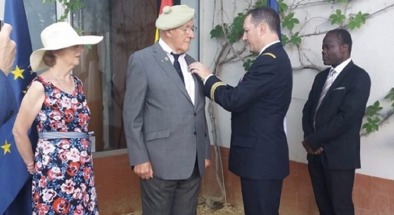
Joe receives the Legion D´Honneur
And to his amazement Korvettenkapitän Gunter Jahn, the Commander of the U-boat, U-596 that sank his ship, and who went on to become one of the most successful U-boat commanders in the Mediterranean Sea, was truly delighted that Joe got in touch.
Gunter Jahn – U-Boat Commander 30.3.43
Follow the story of the battle his survival and the subsequent friendship of the cabin boy and the U boat commander, told by Joe himself.
Memories of a D-Day Hero
In edition 770 The Leader carried a story about D-Day Veteran Joe (aka The Cat Man) Billet and his trip on “The Voyage of Remembrance” aboard the SS Boudicca for the commemoration of the 75th anniversary of the D-Day landings in Normandy. Nearly two years on we are able to feature his exploits once again as Joe relates the story of one of his many North Africa trips.
The story is told by Joe himself
I joined the SS Fort-a-la-Corne in Newport; she was loaded with ammunition, weapons, food, Army trucks etc.
We crossed the Bay of Biscay and were past Gibraltar when all hell was let loose with U-boats, Italian and German air craft. All the guns in the convoy opened up, they kept at us until darkness and again the next day.
Ships were sunk, some were hit by bombs but we arrived in Algiers. We tied up on the quay north to south, the SS Empire Standard tied east to west on the quay. She already had a hole in her from a U-boat during one of the attacks but an Italian plane dropped a torpedo on her and she sank where she was.
Six of the crew were killed and about a dozen dock workers.
On March 29th under cover of darkness we slipped out to join a convoy heading home but as soon as the dawn broke we found ourselves under bombardment once again all through the day until night fall. On the next day, 30th March 1943 at first light the air attacks were back again.
It was still daylight but I finally managed to get some food from the galley. The stewards served the officers in the saloon, I sat in the corner of the pantry and ate. They all finished and left, I cleaned up all the dishes, cleaned the floor, picked up some corned beef, went to my cabin, gave skipper my cat a hug and fed her.
I then went aft to see my friend Tasker, but he was in the focs’l, so I stopped to talk to Paddy when a torpedo struck the ship and knocked us to the deck.
We jumped up when another torpedo struck us, I dived out the door and made my way amidships.
The two lifeboats were smashed so I went to the starboard where one boat was clear of the ship but the other one was hanging from the derrick useless.
An ordinary seaman stood next to me and said we have to jump as far out as we can. He grabbed hold of my hand and we jumped.
I came to the surface and swam to the life boat and they hauled me in. It was now about 7pm. The convoy had gone, the lads saw a raft with a couple on it so some of them swam over to it and tied it to us so we did not drift apart.
At 3.30 am the crew of the escort ship HMS Albacore came along side us and the captain shouted to get aboard as quickly as we could, there was a scramble net hanging over the side so up we went.
Miraculously, the master, 43 crew members and ten gunners from the Fort a la Corne, Master Reginald A. Grove, were all picked up.
Once aboard we had a cup of cocoa or tea, the P.O grabbed me by the arm took me below and said “that is my bunk and I am on watch so you get your head down”.
We landed in Gibraltar and a couple of days later the Troopship Empire Halladale took us to Liverpool.
Letter from Gunter Hahn
Many years later I began corresponding with Korvettenkapitän Gunter Jahn, the Commander of the U-boat, U-596 that sank my ship. Gunter went on to become one of the most successful U-boat commanders in the Mediterranean Sea, eventually becoming the commander of the 29th U-boat Flotilla.
Lance Corporal Joyce Lee WWII Veteran
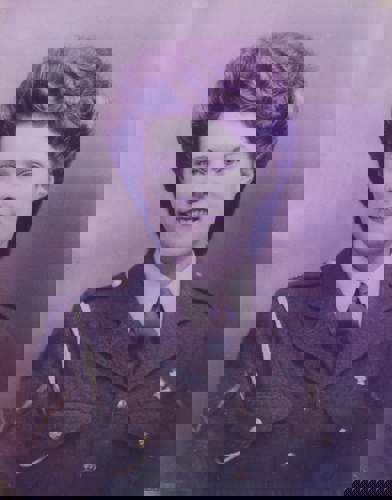
Joyce Lee, is a 2nd World War Veteran, has just turned 101 years old and continues to live life with joy and energy. he big smile reflects her kind heart, strong spirit. Joyce was born in West Yorkshire in 1924, the daughter of Sally and Alfred Goodall. at just 16 rears old Joyce lied about her age to enlist the Auxiliary Territorial Service (ATS). After completing her training she was assigned to the 524th Heavy (Mixed Anti Aircraft Battery) part of the 152 mixed (Heavy Anti Aircraft Regiment), she was promoted to the rank of Lance-Corporal. Joyces military service was officially rated as exemplary. she was awarded the Defence Medal and the War Medal 1939-1945. she served at Spurn Point and Stone Creek Between Hull and Stern Heads, sights that played a key role in defending Britain during the war. these locations were part of major Antiaircraft operations and were staffed by both men and woman. Joyce worked there as a Radar Operator, along side other ATC Members. During the war, Joyce met her husband, together they raised 4 children. For the past 12 years Joyce has lived in Spain with her daughter Sue, continuing to enjoy life with the same strength and cheers she showed in her youth.
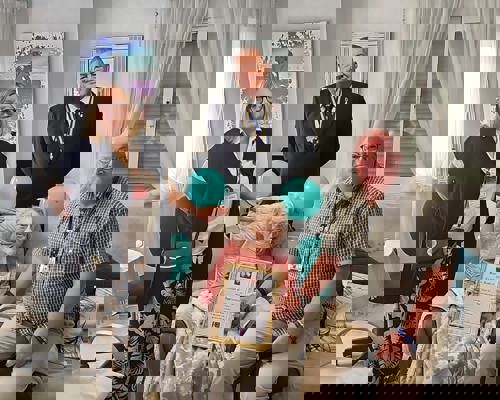
Joyce pictured with Spain District North Chairman Mr Paul Kane presenting her a certificate a certificate of appreciation with our welfare team Mark & Julie Benton
RECOLLECTIONS OF A WW2 HERO
Geoff Matthews is a member of the Orihuela Costa Branch of the Royal British Legion. He recently celebrated his 93rd birthday, with members, family and friends, in Campoverde.
Like many members of the branch Geoff has a tale or two to tell about his military service but one story that stands out above all others is his involvement in the rescue of dozens of survivors from the British merchant Dumfries, that was torpedoed and sunk by German U-boat U-322 south of St.Catherine’s Point, Isle of Wight, on 3rd December 1942.
Geoff was a Petty Officer on the converted trawler HMS Pearl at the time, and as such a particularly important member of the crew.
 |
| The first of our 'recollections' is a story provided by Geoff Matthews, circled above, who was Petty Officer on HMS Pearl when it rescued over 50 members of the crew of the British merchant Dumfries, while on convoy duty in 1942. |
Geoff was a Petty Officer on the converted trawler HMS Pearl at the time, and as such a particularly important member of the crew.
HMS Pearl was commanded by T/Lt. B.G. Barfoot, RNVR and in December 1942 it was serving as escort to convoy PW-257 between South Wales and it’s home base in Plymouth. All the crew were on deck as no one was allowed below while the convoy sailed through "E boat alley".
Just before 6am, still in pitch darkness, Geoff heard a loud explosion to the stern of HMS Pearl. He turned to see that the Dumfries had been badly hit by a German torpedo, and was listing.
The Pearl could not remain stationery as it would have been a "sitting target" so the skipper told his crew to take on board any survivors they could as quickly as possible, but not dead bodies.
They lowered a small lifeboat, a Carley float, and also trailed a net over the side of the ship.
Geoff and another seaman were in the netting with one foot in the water whilst holding on to the net with the other arm. All the while they were trying to catch the survivors from the Merchant ship Dumfries who were drifting past.
Geoff remembers one man in particular who was extremely difficult to haul aboard as he was wearing a flying suit with the zip completely open, resulting in it being completely waterlogged. All the pair could do was to hold him up against the side of the ship until the Carley float came alongside and hauled him aboard.
The survivor was taken into Geoff’s galley while another survivor from the Dumfries tried to revive him, but unfortunately he died without regaining consciousness. Another man died in the Foc'sle where the sailors lived and slept.
However Geoff and his crewmates managed to rescue 41 crew members, eight gunners and two passengers, while another trawler rescued a further 40. All of the survivors were mostly covered in oil.
Just two hours after the incident HMS Pearl was back in harbour and as it had been covered in oil from the sailors plucked out of the sea the crew members were granted 3 weeks leave while the ship was cleaned up.
As far as Geoff recalls, apart from the two sailors who died, all of the men rescued survived their experience.
Geoff, who is circled in the photo of the ships crew below, said that he was sure that he felt the presence of God during his rescue experience as the sea was normally very stormy at that time of year, but while they were working hard to pick up survivors, the sea was flat and calm.
Mark Benton - Veteran
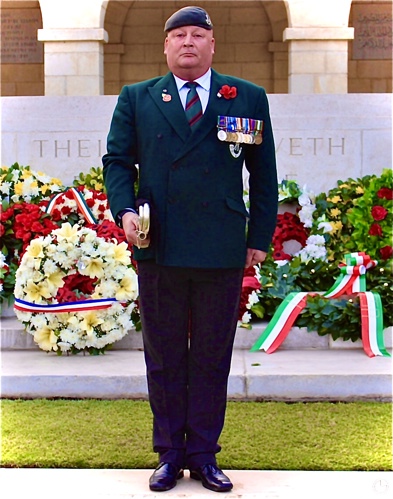
Mark Benton - Veteran
I served for 28 years in the British Army, I started my career within the 1st Battalion The Light Infantry, whom were posted in Omagh Northern Ireland, whilst on patrol as an 18 year old, my section encountered a Terrorist unit believed to be part of the IRA, we stumbled across a weapons and ammunition cache, they did not want it to be found, with the exchange of gunfire, a fire fight followed and the Terrorist suspects were overthrown and arrests were made, minor injuries were sustained, following this incident I was awarded a Mention in Dispatches (MID) 1LI were due to commence a ceremonial tour in Berlin, (BOAR) I was fortunate to be there when the Berlin Wall fell and German reunification. On return back to the UK, I was finally given a sunshine posting in Belize, for a 6 month tour. I was then posted to the 2nd Battalion of the Royal Green Jackets in Dover part of the ACE Mobile brigade, Norway became my 2nd home.
On completion of my tour in Dover and then was posted back to Germany (Paderborn) I was able to serve on postings back to Belfast for my 4th tour a totaling 4 years, it was a very eventful tour, with ups and downs, following this tour of duty in Ireland & I was then was continued my posting in Germany, (BFG). I spent 12 years in Paderborn, it was a fantastic posting with tours of duty in many locations, such as Bosnia & Kosovo, I served with the UN with IFOR, SFOR & KFOR in total 5 tours of duty on peacekeeping missions equating to almost 5 years on operations, all of them came with challenges Again ups and downs both mentally & physically, with exercises in Cyprus, Oman, Norway, Canada, Poland, Belize, Brunei, and all over Germany.
On my return back to the UK, I had the privileged to become a Section commander instructor & on promotion I was made a Platoon Sergeant at the Infantry Training Centre ITC in Catterick, this was my favourite posting as I was able to train recruits and share my experiences.
Following my tour of ITC Catterick I was posted back to Northern Ireland for a 6 month tour of duty. Shortly on my return to Bulford in Wiltshire with the 4th Battalion the RIFLES I was deployed to Iraq on Op TELIC 9 &10 for 8 months, my tour was extended due to manning constraints, what seemed to feeling a 6 month break in tours for operational tours I was then redeployed on tour to Afghanistan on Op Herrick. My last role in the Army was in Charge of training new intakes of Soldiers to my Battalion who then went on to Op Herrick in Afghanistan. I was then assigned to a role in the Intelligence Corps as a Training Warrant Officer, following this role, I was employed by the Multinational Force & Observers (MFO) I was employed as a Military, Intelligence Operator, based in Egypt for 4 years.
I had the privilege to learn to fly a Glider as a solo pilot, Ive climbed Mt Everest & met the Queen during her tour of the country of the UK during her Diamond Jubilee celebrations as she personally decorated me with with my Jubilee medal , I was also the Guard Commander in Salisbury on her visit of the South West.
Since early 2021, I have been a Welfare, Caseworker for Spain District North, providing much needed and welcomed the support from the Royal British Legion to serve our Veterans & Beneficiaries. I have delt with many complexed cases regarding my welfare support, I find my role as a voluntary case worker very rewarding. I think its important to be able to communicate to our ageing Armed Forces Veterans & Beneficiaries the support that we can give here in Spain.
January 9th 2026, I was elected as Branch Chairman of the Orihuela Costa & District Branch. Following a 3 Year period of District run administation, I was able to form a Committee which in turn, allowed us to bring the Branch out of adminstration. To date, we won 2 major awards within the whole of Spain Disitrict North, Recruiting Kukri & The Fallen Hero award as a branch we are all very proud of these awards, ensuring that we as a branch operate and keep to the high standards.
I am very proud to be the districts Bugler, I have attended many parades and events, most notably attending several memorial services to our late Queen Elizabeth. I have supported many Veterans Funerals, raising the profile of the British Legion In Spain. I am honoured, humbled & happy to be able to pay the ulitmate respect to our fallen veterans & make sure that they are dispatched with dignity.
I was proud to serve, if I could, I would do to all again!, I've had the backing and support of my wife Julie, who was at home with the children whilst I was away playing Soldiers
“ Service Not Self”
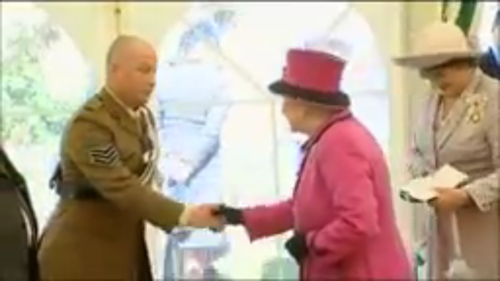
John Clifford Lord Nickname " The Voice"
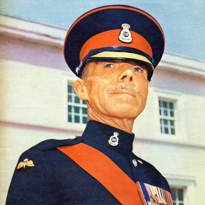
John Clifford Lord (26 April 1908 – 21 January 1968)
Was a former regimental sergeant major (RSM) and First Academy Sergeant Major at Royal Military Academy Sandhurst. He also notably participated in the Battle of Arnhem during Operation Market Garden in September 1944 as a member of the 3rd Parachute Brigade (United Kingdom) as a British Army paratrooper who saw service during the Second World War.
After being captured by the Nazi Army and imprisoned in Stalag XI-B, he was known for his courage and leadership. He insisted that the prisoners dress properly, instituting morning parades and physical training. When the guards deserted the camp in April 1945, Lord organised formal guard duties on the camp gates and the liberating troops were astonished to find a disciplined, organised camp with the prisoners better dressed than themselves.
On the 30th November 1959 - John was the subject of an episode of "This is your Life"
where he reconnected with Many of his former Army colleagues and cadets Including King Hussein of Jordan and Major General Urquhart Commanding officer of the Army's 1st Airborne Division in Arnhem during Operation Market Garden.
Geoffrey John Thomas
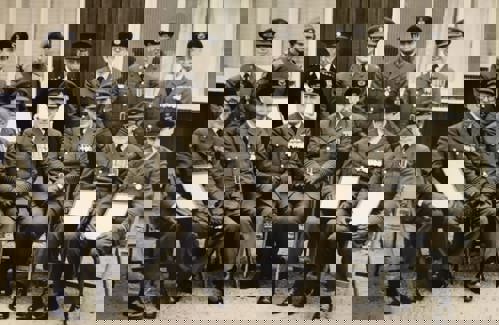
GEOFFREY JOHN THOMAS
MILITARY
I joined the Air Training Corps, 215 (City of Swansea) Squadron as a teenager and after 7 years attained the rank of Cadet Warrant Officer and then a Full Warrant. During this period I was a trumpeter, progressing to leading side drummer (tipper). At 15 years of age I trained and flew solo (illegally) RAF Kirby Cadet and Sedburgh Gliders both with open cockpits. I say illegally, as I was underage having mis-represented my date of birth.
In 1971, 215 Squadron was awarded the Sir Alan Lees Efficiency Trophy having been judged the most efficient Squadron in the U.K. At that time I was Marching Band Master (Band comprising – E Flat Cavalry Trumpets, Base and Tenor Drums & corps of Side Drums). Additionally, I had trained a Marching Continuity Rifle Display Team (Lee Enfield 303’s with blanco’d rifle slings), based on a program provided to me by the RAF Regiment Queens Colour Squadron.
Interestingly, the first Commanding Officer of 215 Squadron was Sir Artur Whitten Brown of Alcock and Brown fame. Alcock and Brown were acclaimed for making the first ever Transatlantic Flight in 1919, doing so in a Vickers Vimy Bomber.
I was commissioned in the Royal Air Force Volunteer Reserve (Training Branch) for 17 years and attained the rank of Flight Lieutenant – appointed to a variety of duties (jack of all trades -probably master of none) – specialising in foot and arms drill and ceremonial. I had the honour to be selected, as an Usher, to attend a Royal Service of Dedication in St. Clement Danes (Central Church of the RAF) in The Strand. Thank goodness my surname starts with the letter ‘T’ as I would have been escort to Members of the Royal Family.
CIVILIAN
By profession, I am a Fellow of the Royal Institution of Chartered Surveyors and served for 26 years in the Valuation Office Agency, Board of Inland Revenue. I was appointed Licensed Property Valuer for Wales and subsequently attained a Statutory Appointment as District Valuer & Valuation Officer (Rank, Senior Principal - Military equivalent – Group Captain / Colonel / Captain).
I ended my career in Private Practice as a Consultant in Rating
Robert "Bob the Bandit" Smith
Robert Smith was Born 21st March 1960, Education, Plume School – Maldon CSE’s. Chelmsford College - Bricklaying Apprenticeship/Master trowel, ONC
Enlisted 1980 – served with 29 Cdo, 40 Regt RA then various units after transferring to AGC in 1993. Completed 35 years’ service. Served in Falklands, Northern Ireland, Canada, Gulf (Op Telic), Germany and various other countries. Finished Service as Warrant Officer Class II
Married to Jane, has a son named Rhys and is a retired Veteran.
John Lord - REME Veteran
John Lord Service Number 23968034. Date of joining March 1963 the RoyaL Electrical & Mechanical Engineers (REME), Reported to the Army Apprentice School at Arborfield to train as a Vehicle Mechanic.
Left there in 1966 as a class 2 mechanic. Posted to 5 Infantry Workshop in Dortmund Germany, after a few years we were pulled back to the UK as Harold Wilson devalued the pound and withdrew 5 infantry Brigade to the UK.
Spent a year in Catterick then was sent to do a 6 month secondment in Libya, at the RAF station in El Adam.
The day we flew Ghadafi seized control from the King. This involved the cancellation of the Battle Group who were due out, so as the had nothing for us to do we were attached to the RAF maintenance garage, which was the cushiest time of my service, no parades just turn up for work on time.
We were flown back to RAF Brize Norton and then posted to Bunde in Germany serving with 33 squadron 2 DIV of the Royal Corps of Transport RCT. Where I was discharged in 1974 as a class 1 A & C Mechanic.
Lt Col (Retd) David Blow
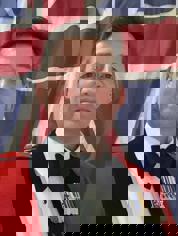
David Blow retired from the Royal Engineers in early 2024 after 22 fascinating years of service.
Having started professional life as an architect working on the bomb-damaged reconstruction of central Manchester, including the design of New Cathedral Street and Exchange Square, David undertook a 2-year full-time reserve service appointment in Army HQ before transfering to Regular service in late 2001.
After operational tours in Kosovo and Iraq he undertook the Army's Professional Engineer Training (PET) Course to charter as a civil engineer, the precursor to the rest of his career planning, designing and delivering infrastructure in interesting places around the world.
Highlights include initiating the construction of Camp BASTION, Afghanistan in early 2006 and development of military infra throughout Afghanistan during a second tour in 2008; restructuring the PET course during his tenure as its senior instructor, to make it more accessible and fit for purpose; running the €4bn maritime programme when assigned to NATO in Norfolk, Viginia to develop NATO's maritime support infra capability; and his final assignment overseeing the infra development and maintenance of the 6 sites and 7 schools that make up the Royal School of Military Engineering Group.
Since retiring he has been hands-on refurbishing his Edwardian terraced house in Manchester, work that is interrupted frequently by visits to see his daughter at university, road trips, playing golf and soaking up the sun at their home on the Costa Blanca.
Maj (Retd) Ian Connell
Training as a toolmaker during the late 60’s and early 70’s, I was supplementing my meagre wages from weekends spent with the Territorial Army, I was a Sapper in 102 (Clyde) Field Squadron, Paisley, part of 71 Engineer Regiment!
Apprentices were poorly paid in those days and a married apprentice toolmaker with a baby on the way did not bode well. Service in the Sappers changed the focus in my life, I realised I had to complete my apprenticeship, but I knew from my weekend, and annual camp experiences that I did not want to spend the remainder of my life in a factory!
After three years TA service, in 1973 I joined the regular army!
My first experiences of military life were arriving at Southwood Camp, a massive wooden hutted collection of accommodation blocks called “Spiders”, having travelled for what seemed days from Scotland on an overnight steam train, through London and out again to Farnborough!
Basic training was tough but enjoyable, long days, and nights, 6 days a week, with Sundays off unless you’retraining party was on guard duty! Training lasted 6 months and, in that time, we were turned into soldiers then into Combat Engineers, self-sufficient self-reliant and a marked improvement to the men we were on enlistment!
In February 1974 I was reunited with my wife and daughter in our first posting at Ripon and was delighted to get issued our first Married Quarter, whereupon we could restart our married life. It was a very sparsely furnished terraced house but it contained every item you needed, right down to teaspoons, cups and glassware, oh how I miss the G plan armchairs and settee with the green and purple psychedelic seat covers!
OH, nearly forgot the matching curtains …. yuck!
Ripon in those days was a lovely market town (it’s actually a city), and our unit was what was called a Strategic Reserve Regiment, that meant that our Squadrons were in a role that could deploy us world-wide at very short notice, and we did! I remember halfway through my JNCO cadre, I was deployed to Northern Ireland because of a national strike! Seven days later the workers had gone back to work and we re-joined the cadre, not many soldiers do an NI tour during their JNCO training course!
More tours of Ireland ensued as did excursions to Sudan, Belize, Oman and Germany on many Harrier exercises, what a machine the Harrier Jump Jet was, truly awesome!
Whilst all this was happening (22 months separation in a 36-month posting), my wife was happily raising our family!
The next thirty odd years included many postings in England and Germany, and a winter sightseeing tour of Bosnia, amongst various excursions all over the world, including Combat Engineering and Bomb Disposal, quite an interesting discipline to master!
The Royal Engineers are responsible to the Armed Forces for, Mobility, Counter Mobility and Survivability!
Royal Engineers on posting are what’s called trickle posted that is, the individual is posted to a unit, rather than the whole unit being posted, postings normally followed a promotion.
Just when you were getting used to a new rank or appointment, things would change!
Change is one of the constants of the universe, and how we deal with it is important. Throughout my 35 years of service, if it wasn’t a new Officer Commanding or Commanding Officer trying to make his mark, it was new doctrine, a different or better way of doing things was discovered, and it was all change, just when you thought you had it cracked it changed!
So, from toolmaker, to Sapper, through all the soldier ranks including RSM I retired as a Major, and I am looking forward now, to retiring from my second career (the RBL)
I am a rifleman & will come for you
I will disregard your fire with each frenzied round, each frantic shot,
For if you show yourself to fight
Infernal day or stygian night,
Have faith that you will miss and I will not,
You will slow me down with hidden traps and buried threats
With every measured stride, ill taste the familiar dead,
Ill sound the advance and drive and march to see your challenge met.
Where you have looted, bullied and crowed,
I will empower and protect to see the Afghan proud,
My only theft is his fear, my levy only trust.
I will stand in sombre salute, to the coffins you create,
Console those you have bereaved and nurtured those you have maimed.
But I'll blind my thoughts with blame,
Nor surrender my soul to hate.
When I am home, I'll touch my soul to hate.
To cold apathy and gathered crowds the same,
In certain knowledge that I will come again.
To this fertile, futile half forsaken place,
I am Swift of thought and Bold of heart
So heed this warning I impart.
I will come at you with everything I can,
For I am and always will be a Rifleman
Rifleman, Afghanistan 2009