Whitchurch Branch, in keeping with many nationwide was formed in 1921, although records no longer exist to tell us where they met or indeed who were members, Lord Denning was our founding Patron and remained closely associated with the branch until his death in 1999. The Denning family, like so many in Whitchurch, suffered personal loss during the First World War losing two sons Jack (killed in 1916) and Gordon (died at Jutland 1918).
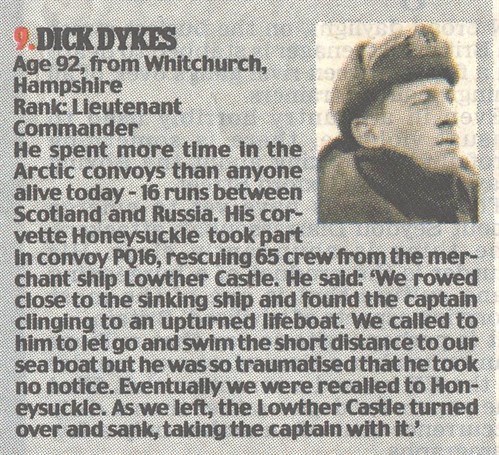
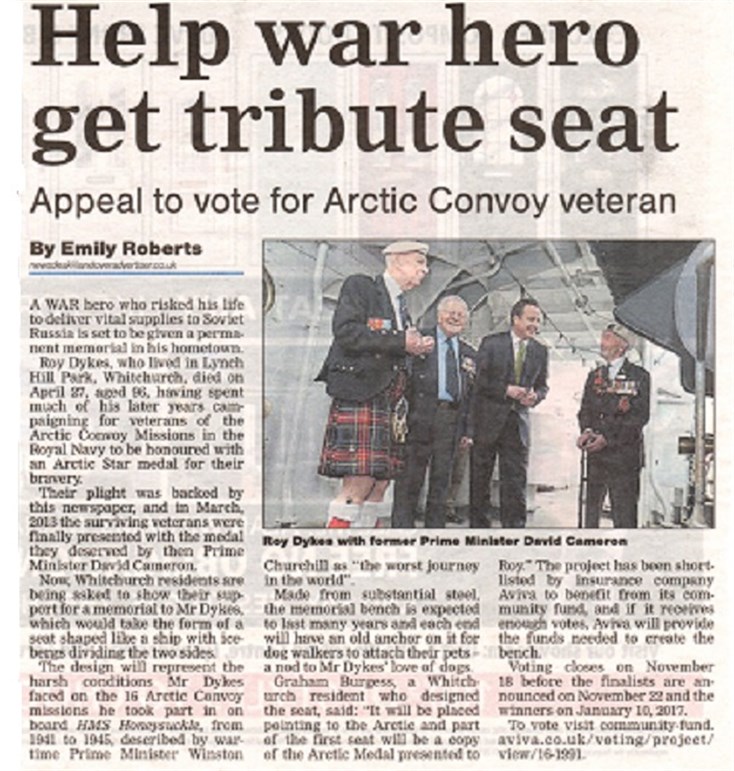
The Branch was suspended during the Second World War from 1939 to 1945, but since its reformation in 1945 it has met monthly and continues to do so to this day. Many of our Branch Presidents have had illustrious careers, General Adam Block, General Sir Alan Cunningham and Mr Roy Dykes a form Lt Cdr RNR who served on the Arctic Convoys and whose bravery and contribution to ensuring the survival of the Soviet Union was recognised twice by the Soviet Government. It took the UK Government until 2014 to do the same. Following the death of Roy Dykes in April 2016 our current President was elected in November 16 – Mr Ken Clark a well-known retired business man and a long standing member of the branch.
The branch has met in numerous locations down the years, at The Red House until a falling out with the Land Lord, the community Centre and now The Bell Inn. There remains a strong Naval tradition in the Branch, although the other two services are growing in strength. The old guard retain their annual ‘Bully Beef Supper’, traditionally held during our May meeting, the only absence being the Bully Beef, which thankfully is no longer produced!
On the 4th August 2014 the Branch commemorated the centenary of the outbreak of the First World War. A service at the Town Hall had to be moved outside as the numbers attending were too great to fit in the Council Chamber. A simple candle lit act of Remembrance conducted by Rev John Beadle, the Methodist Minister and former RAF and latterly RN Chaplin was attended by over 200 people. The event was followed by a month long exhibition in the Town Hall commemorating the contribution of Whitchurch during the Great War and remembering the 64 men of the Town who gave their lives.
In today’s media savvy world, the use of the word hero is all too a common place. Generations past served, suffered in silence and asked for nothing in return, yet among their ranks are many who we would now refer to under the hero’s banner. The current membership boasts veterans from WW2, Malaya, Northern Ireland, The first Gulf War, The Balkans Campaign, Sierra Leone, The second Gulf War (Iraq), Afghanistan. Within the Town there are also veterans of the South Atlantic (Falklands War) as well as a healthy number within the community who continue to serve in all 3 Services.
One hundred years on, Servicemen and women are still suffering injury and the threat of death. Today the medical support is far more advanced than during WW1, however recent conflicts have demonstrated all too clearly the price that many service personnel pay to defend our freedoms. As it has done since 1921, the Whitchurch Branch will continue to support all ex-Service personnel and their families, not just initially, but for as long as it takes.
|
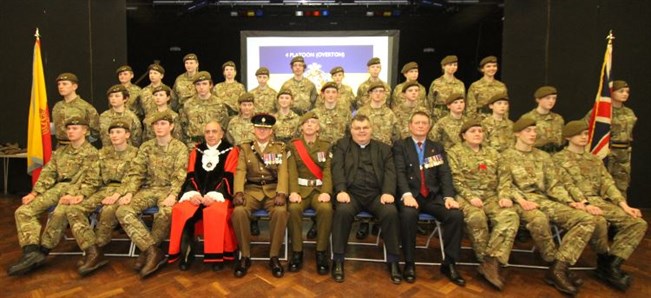
Affiliation Ceremony 2016
|
Ken Clark – Experience in India whilst in the Royal Navy
Across India by Troop Train
After spending three weeks on a troop ship we landed in Bombay (now known as Mumbai) - the gateway to India.
The first night was spent in a camp just outside the city of Mumbai which has a population approximately of seventeen million as of 2017. The following morning we boarded a troop train with our ultimate destination of Visatapatam.
Our only tropical kit was white shirts and shorts. There were six sailors to each compartment, which had wooden seats with beds overhead and converted into six berths. This compartment was our sole home where we sat, ate and slept for the entire journey. There were no through connections, which meant that lengthy stops for provisions, i.e. where meals were provided, we washed our utensils in vats of water, also took the chance to refresh ourselves.
On the approach to the Western Flats just beyond Kohardi, the train began to climb with the line twisting and turning, passing through several tunnels. The temperature began to drop feeling colder and the landscape provided wonderful views over the plain below.
From this point the line undulated over a rather barren plain, dotted with villages until we arrived at Doolalih; for any troops this was a desolate testing place, which gave its name to Doolally, a nickname for a form of madness.
From Doolalih we changed from an electric loco to steam and continued our journey by climbing to summit of the line, at a height of 2,999ft.
During the night the train stopped at Sonerpur, and the station boasts the longest platform in India, and then we continued on to the city of Nagpur. Nagpur is the city where a young Sir Cliff Richard was living with his family. At that time his father was working for the railway.
We left the train at this point as it was going to Calcutta and we were going to Visatapatam, a naval base on the coast of the Bay of Bengal.
With the change of train we joined a passenger train with reserved compartments for our troops. For our food we ate at the restaurant on the station in sheer luxury while the train waited outside! Our journey came to an end after 1,300 miles, lasting three days and two nights, and this was a great relief as we had not been able to wash or change our clothing.
As the crossing of India came to a close, one was left with wonderful memories of a truly unique railway journey, set in unbelievable scenery.
After the war had finished with Japan, four months after we had arrived in India we set off again to Madras and down through Pondocherry, the French part of India, to a place called Danish Khodi. We were now in khaki uniform and we boarded the ferry to Ceylon (now known as Sri Lanka) and then stopped at a village 30 miles from Colombo called Veyangoda.
Veyangoda was my base for 14 months out of a two year commission until I boarded a aircraft carrier to return home.
K J R Clark – Ex First Class Stoker – PKX603734