The Poppy Appeal in Waterside
Waterside Branch and its poppy team have shown its fundraising skills by raising in excess of £ for
So well done to all who have helped with collections and a big Thank You to all the people of Waterside who have been so generous again.

Northern Ireland
Poppy Appeal
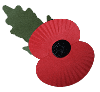
Each year the nation expresses its unequivocal support for the Legion's work through its generous support of the Poppy Appeal. The Poppy Factory in Richmond, London, produces millions of poppies every year, along with the wreaths laid at Remembrance services around the country and the poppy petals that fall at the Festival of Remembrance at the Royal Albert Hall.
It takes 350,000 volunteers and staff to organise the Poppy Appeal each year. Money raised goes to support our welfare work for the Armed Forces community.
Why poppies?
The First World War caused widespread devastation to areas of Northern France and Belgium, but the poppy flowered every year, bringing colour and hope to the devastated landscape. Lieutenant Colonel John McCrae, a doctor serving with the Canadian Armed Forces, was deeply moved by what he saw and, inspired by the poppies, wrote a poem - In Flanders' Fields. McCrae died in a military hospital on the French coast, but it was published in Punch magazine, showing the world what conditions on the battlefields were like.
In Flanders' fields the poppies blow
Between the crosses, row on row,
That mark our place: and in the sky
The larks, still bravely singing, fly
Scarce heard amid the guns below.
On the eleventh hour of the eleventh day of the eleventh month in 1918, the WW1 ended. Thousands had died, thousands more had been injured and scarred by their horrific experiences, and needed support and practical help when they returned. For those people and their families, life would never be the same again.
Civilians wanted to remember the people who had given their lives for peace and freedom. An American War Secretary, Moina Michael, was inspired by John McCrae's poem, and sold poppies to raise money for the ex-Service community. And so the tradition began.
 In 1922 Major George Howson MC, who served in the First World War, founded the Disabled Society. He recognised unemployed ex-Service men could make artificial poppies and approached the Legion. He founded a small factory, which was later to become the Royal British Legion Poppy Factory.
More than 40 million Remembrance poppies, 500,000 poppies of other types, 5 million Remembrance petals, 100,000 wreaths and sprays, 750,000 Remembrance Crosses and other Remembrance items are made at the Poppy Factory each year.
The British Legion - now the Royal British Legion - was formed in 1921 from four separate ex-Service organisations. The first official Legion Poppy Day was held in Britain on 11 November 1921.
Follow the Poppy
Watch our fun, interactive visualisation of how your donations help the whole Armed Forces family.