From the RBL, for Sunday 6th June, D-Day 77 Livestream | Remembrance | Royal British Legion
Proud to say my Dad was there, Dvr Rogers R.E.
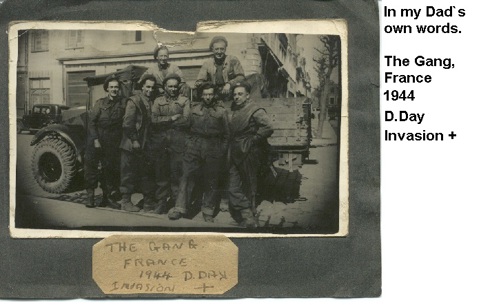
My father was John Arthur Rogers, born in Forty Acres Lane, Canning Town in May 1924.
He went to Rosetta school in Custom House.
Once he left school he got a job in a Greengrocers and Butchers shop, and two weeks after his 20th birthday, my Dad stormed the beaches of Normandy to free Europe from the Yoke of Nazi rule!
He did not do this on his own, a couple of his mates came with him and a few other lads from around the world, plus some friendly Americans he met on the way.
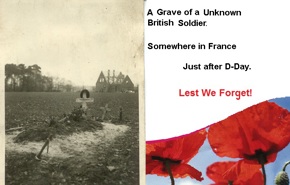
He sadly left some of them for ever on the Battlefields of Europe.
He had been in the local Home Guard (LDV, Local Defence Volunteers), and in January 1943, he was called up and sent to Edinburgh.
After his basic training he joined the Royal Engineers. In April 1943 became a Driver in Royal Engineers.
He then spent the following year being trained for the big day. (Although he did not know that at the time!).
He was based in Edinburgh Castle, the Tower of London, and Longmoor Military Railway.
He was also at the Memorial Avenue Buildings, West Ham, which for some time before D-Day was turned into Army barracks.
He learnt to drive some very big lorries in the middle of the Yorkshire moors in mid-winter.
He finally held a `All Groups Licence` which meant if it had a wheel or a engine, anything from a Motor bike to a Tank, he knew how to move it, and what to do if it did not.
Amongst some of the things he did before D-Day was to drive convoys full of explosives from Essex through the Blackwall Tunnel (they closed it off to normal transport and sent one lorry at a time through, just in case something went wrong!) and then on down to the coast.
On D-Day he was a member of 10th Mobile Railway Workshop, 962 Company Royal Engineers.
He boarded a ship in a big lorry and headed for France.
The Drivers were put in the bowels of the ships and had to stay there, so no daylight and no idea what was happening.
He was due on Gold Beach (sub-section Jig Beach) on D-Day, but owing to a delay clearing the beach, he spent a very uncomfortable 24 hrs bobbing about in the English Channel, before disembarking early on the 7th June.
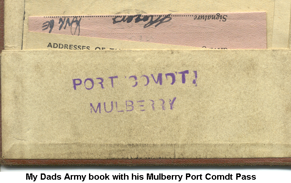
His job was to help to construct the Mulberry Harbour (B) (British).
This is where my Maternal Granddad comes in to the story.
Albert Gregory was born in Stepney in 1895.
He had spent World War One as a member of the Royal Service Corps and would pull everything (other than the Guns) to the `Front` for the Royal Artillery and had gone deaf owing to the guns.
As a Dock Labourer in WWII, one of his jobs was to help build some strange looking objects in the Blackwall Docks, (Part of East India Docks) Poplar, E.14.
It was not until after D-Day, he found out he was helping to build casements for Mulberry Harbour. (It’s a small world).
Soon after the invasion a terrible storm stuck the Normandy coast.
It destroyed the American version of Mulberry, and nearly destroyed the British one.
During the storm, my Dad had to go and rescue some members of the Royal Artillery who were stuck out on the guns at the end of the harbour defensives.
The weather was so rough the roadways could not be used to get to them, and the fear was the Gunners would drown.
Because my Dad’s all group licence, and the fact there was small boat tied up with an Engine and a Steering wheel he `volunteered` with some mates to go out in the boat and get them.
Once the harbour was established, he moved in land.
The first main town they came to was Bayeux, and then on to Cean.
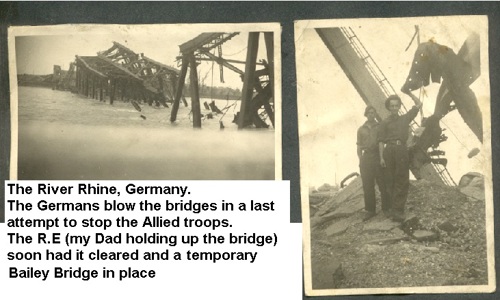
He then fought his way through France, Belgium, and Holland, then finally in to Germany, building Bailey Bridges.
He died in my Arms aged 62 in 1986 from a Heart Attack.
Robert John Rogers.